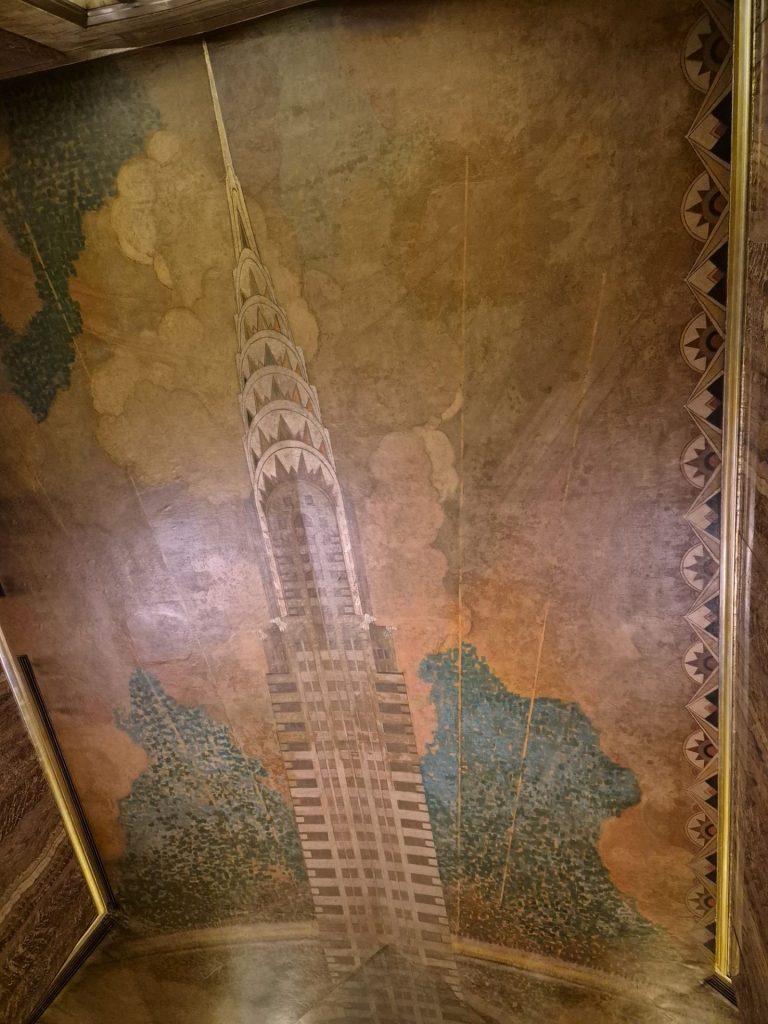
Well, we arrived in New York after a 2 hour wait on the tarmac in Montreal airport and wow, what a city, busy, busy, busy (and very expensive!). Probably not the best place for a claustraphobe like me, but we managed to explore over 2 days without me screaming! It was our first visit here, and we’d arrived in the middle of a federal shutdown so weren’t sure which museums would be open. So instead, we walked for miles, managed to avoid too many heights for Andy (other than a 22 and 26 floor hotel room!!), and have seen a lot of the sites – Empire State building, Rockefeller building and watched folk ice skating in the Rockefeller Plaza, admired the murals in the Chrysler Building,
Chrysler Building Ceiling Mural
stepped into the Grand Central Station Terminal,
Grand Central Station
strolled down streets you hear about on the TV (Madison Ave, Park Ave, Lexington Ave, Hells Kitchen, 5th Ave – all of which are easy to navigate by foot), seen the steam venting up through the streets from the subway running underneath, dodged the crazy yellow cabs, enjoyed the space in Central Park and listened to some excellent buskers there,
Busking in Central Park
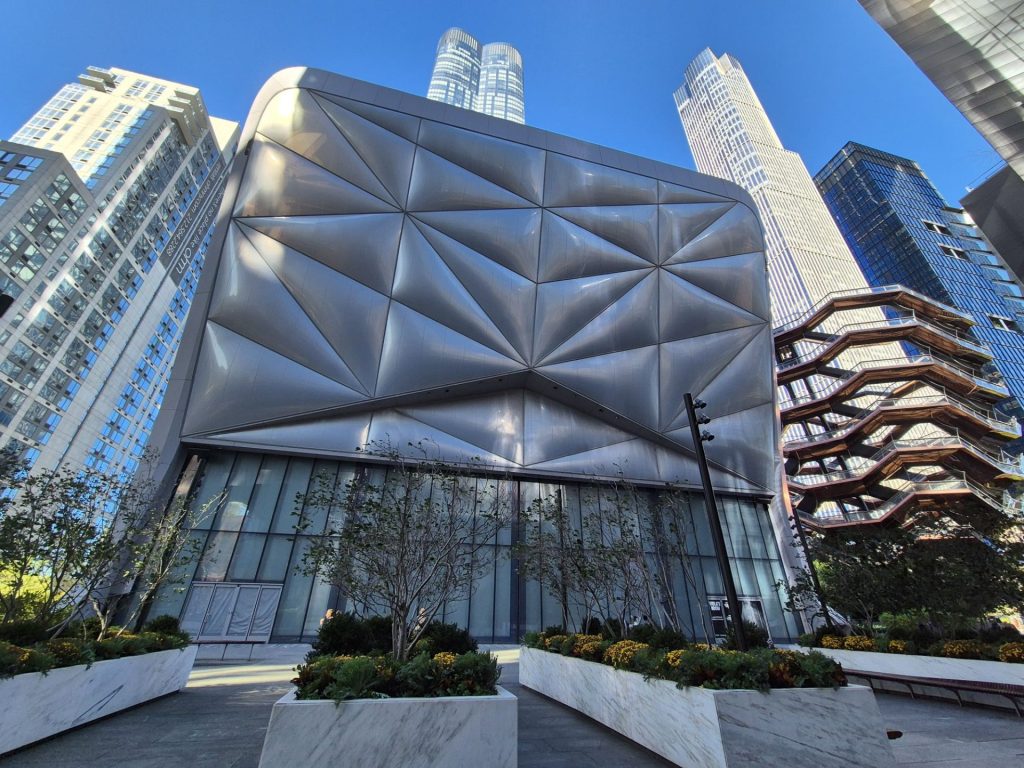
whilst watching young couples having their wedding photos taken, watched the filming of an advert for Theory clothing whilst chatting to the ‘Fixer’ who sorts out the permits for filming, walked the High Line (an old elevated freight railway line that nature has taken over and has now been turned into a wonderful walkway with great views over the city, Hudson Yards, with the Shed (a massive moveable building), the Vessel and the Hudson River),
High LineThe Shed & The Vessel
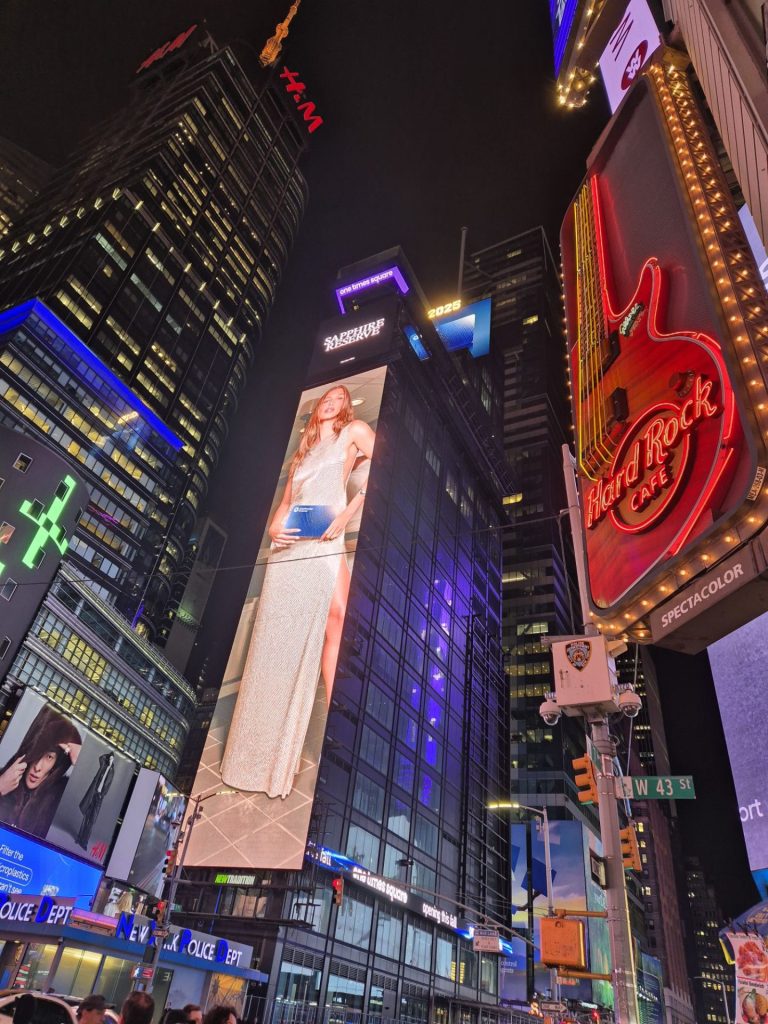
eaten delicious fish tacos in Chelsea Market (the old biscuit factory where Oreos were concocted), walked through Broadway and gotten overawed by the bright neon lights of Times Square.
Times Square
Andy made a friend in a gorgeous golden lab called Ruby who decided his knee was just the right height to rest her head on, whilst we recovered from our walking with a cup of tea and chatted to her owner. Oh, and we did manage to pop into Macys and the Hard Rock Cafe!! We were apprehensive about visiting New York, but we enjoyed the tiny bit we saw in the short time we had. You do get a sore neck looking up at all the skyscrappers and some lovely architecture!!!!!! Then it was time to start our final leg to the UK – via a transatlantic cruise on the Queen Mary 2.
This was our second Cunard cruise and first on the Queen Mary 2.
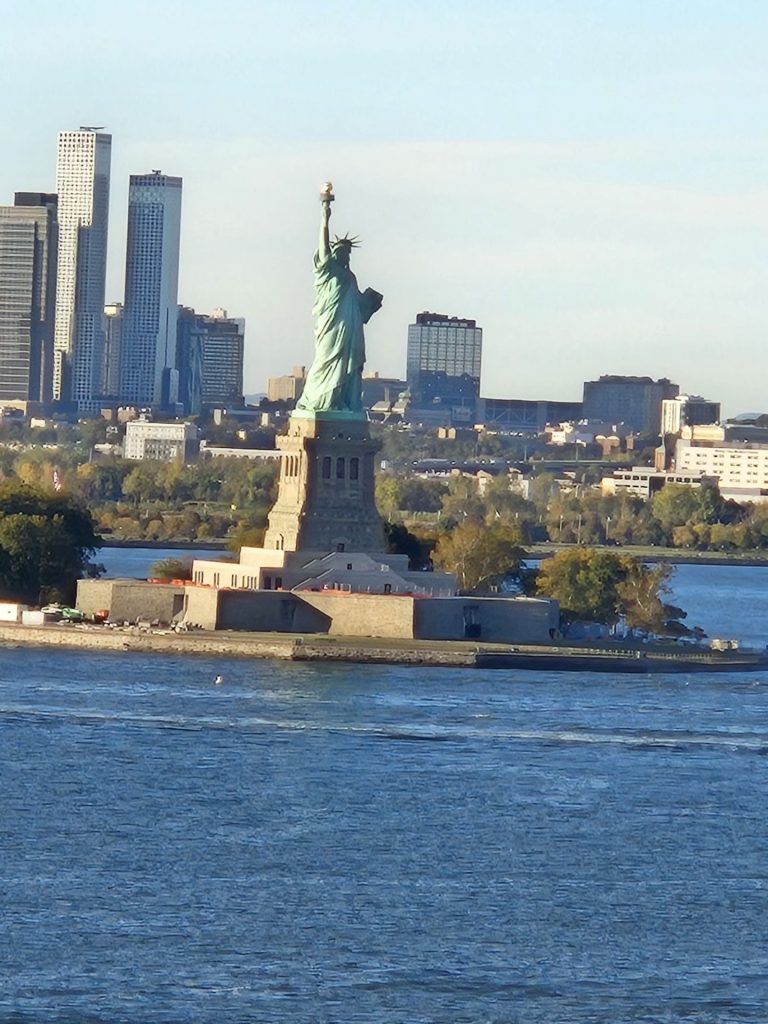
We sailed out of New York, passing the Statue of Liberty,
Statue of Liberty
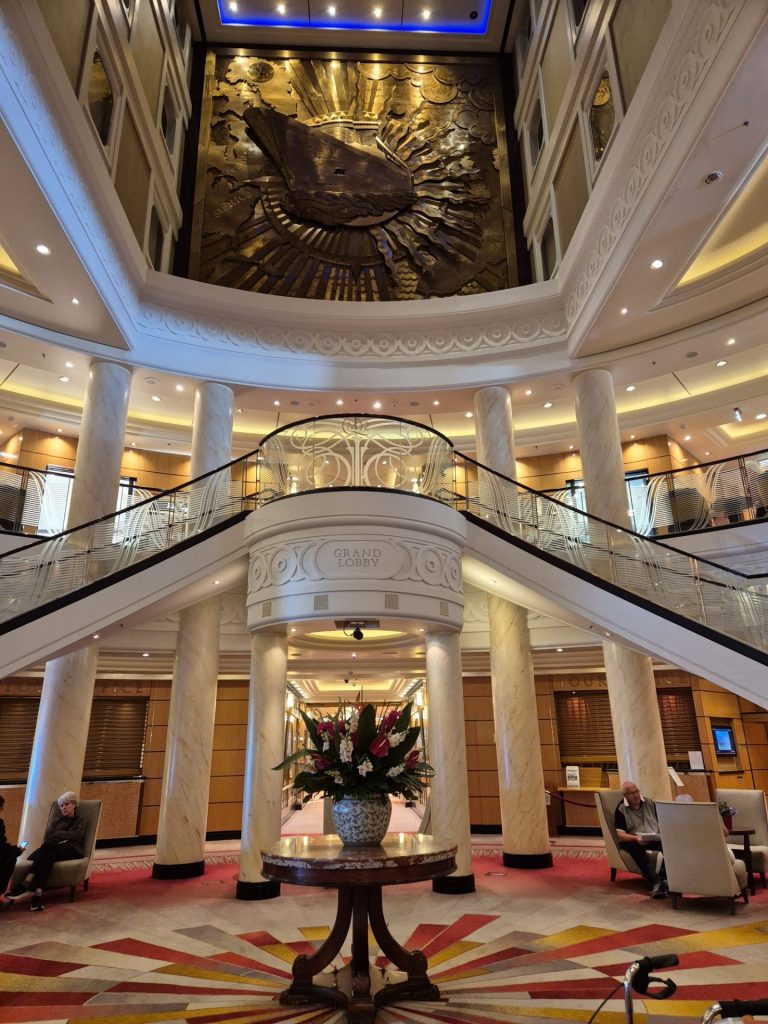
and then, for the next 7 days, had a fairly smooth sailing! The ship is lovely with lots of interesting, informative boards (200 apparently) about her history around the decks. She has a strange layout but with some great quiet spots along with the usual lounges, shops, restaurants etc. Sadly, though, the planetarium experience was not available.
Grand LobbyBritannia Restaurant Ships Bell
We did have a free lesson in roulette, three card poker and blackjack, followed by Andy entering the blackjack competition for fun – and only ended up in the final (and even got to the top of the leaderboard on the 1st day!)!!! Which, of course, he then lost! Our Maritimes trip took 69 glorious days, 1 cruise, 3 flights, 2 hire cars, 1 AirBnB and numerous hotels, motels and B&Bs, exploring Newfoundland, Nova Scotia, Cape Breton, Prince Edward Island, and New Brunswick before heading to New York and then home.
It took us 10 mins and $20 to go back over the Confederation Bridge to start our final Canadian leg of our adventure. We entered New Brunswick in the rain and headed to Shediac for a quick stop – of course, we had to take a photo of the large lobster, complete with witches hat!
Shediac lobster!
Then on to Moncton for 2 nights. We visited the Hopewell Rocks Provincial Park, where you can walk on the ocean floor and admire the massive sea stacks and then 6 hours later see just how high the tide rises (between 48 and 56 feet depending on the moon tides). We were lucky enough to be able to do both of these things – it was amazing to witness.
Low tide versus high tide!
We then drove along to Alma, via the Cape Enrage (another lighthouse), along tiny roads lined with stunningly coloured autumn trees. The leaves are certainly turning here – reds, oranges and yellows.
Fall colours
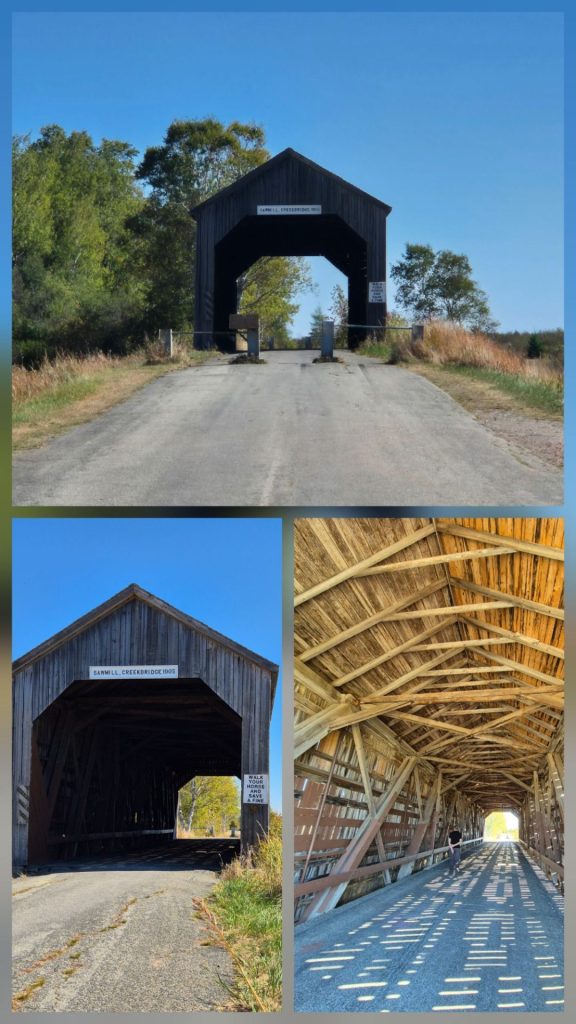
Sadly, photos don’t do them justice. We also came across our first covered bridge – in the 20th century, it seems there were over 1000 of these in New Brunswick! They were covered to prevent the timbers from rotting in the weather.
Sawmill Covered Bridge 1905.
We ended our wonderful day with one of the best Laksas we’ve had since leaving Borneo and a craft beer and good live music in the Happy Craft Brewery – aptly named!
From Moncton we drove to Saint John (not to be confused with St John’s of Newfoundland), via Fundy National Park – the trees are looking gorgeous all through here and the railway museum at Hillsborough (it was closed!!). We spent a few days in Saint John just chilling. We took a drive out on the Fundy Coastal Drive to the pretty town of St Andrew’s on a gloriously sunny day. It is a lovely town to wander around, visit the historic Blockhouse
St Andrews Blockhouse
and lighthouse
St Andrews lighthouse
or just sit and watch the boats in the bay.
Easy to see why it’s been voted one of the best in New Brunswick. Saint John is an industrial city that is also a popular port for cruise ships – 3 at a time during our visit so it got busy! Not a huge amount to see but there’s a historic area to explore, the reversing falls to observe (a phenomenom caused by the high tides hitting the Saint John river), a container village of local stalls to wander around,
Container village
visit the City Market,
City Market
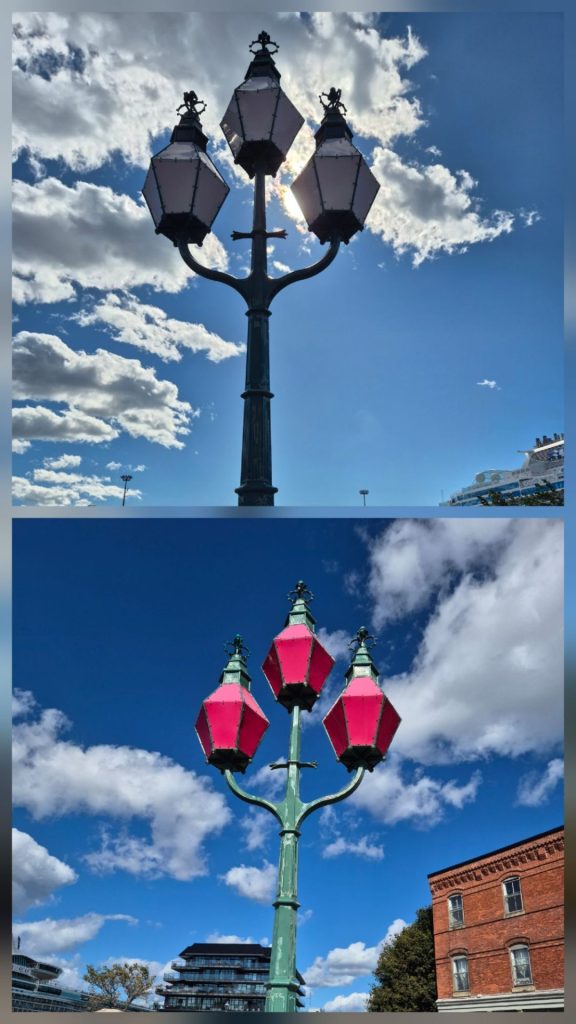
find the 3 sisters (a street lamp of 3 lights coloured red on one side and white on the other – lots of theories as to why it’s called the 3 sisters), which looks out to Partridge Island where immigrants in the 1800’s were quarantined on arrival to North America, with many dying during the typhus epidemic in 1847. The island is now a National Historic Site.
3 sisters lamp
We popped into the Stone Church – beautifully symmetrical exterior sitting on the top of a hill – it’s now a multi use space as well as a church. The huge window came from the UK, packed in molasses to prevent breakages. However, when it was assembled, they mistakenly mixed up the bodies of Mark and Luke and there is also a 3 footed angel on a different window!!
Stone Church
We also took a wander up to Rockwood Park, walking around Lily’s Lake, enjoying a delicious lunch at Lilys restaurant and watching the deer in peoples’ gardens!!
Lily’s Lake
Our next stop was Fredericton, capital of New Brunswick. But first, we had to do a long detour to Hartland – to see, and drive across, the longest covered bridge in the world – a mere 390.75 metres long!!!! It was built in 1921 and uses the Howe truss (iron tension rods) to support the wooden trusses, and it crosses the St John River.
Hartland Covered Bridge
We then drove down the riverside on the River Valley Scenic Drive, through quite agricultural countryside, to Fredericton. The colours of the trees were beautiful. Next day was Saturday and the best thing to do here is visit the Saturday market – wow, so many lovely stalls of local producers, farmers and crafters and where you can still buy apples by the bushel or peck (4 peck equals 1 bushel). We then continued our walk around town, over the Bill Thorpe walking bridge (the old railway bridge and part of the Trans Canada trail)
Bill Thorpe Walking Bridge
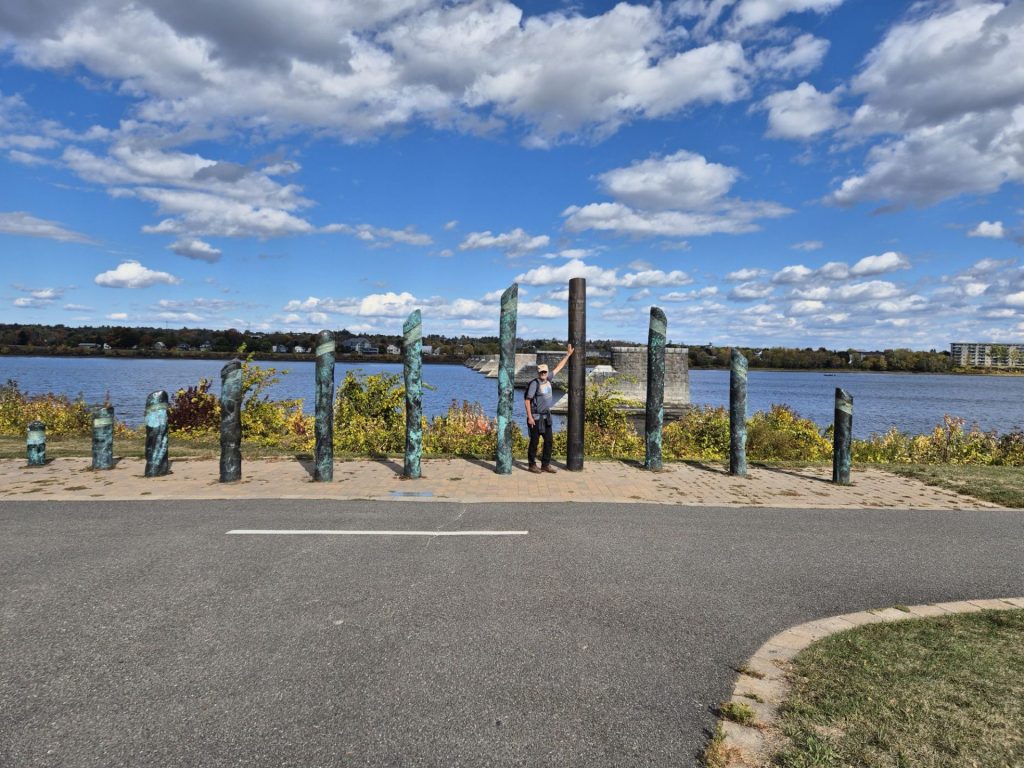
and along the lovely north riverfront trail to a good spot for tacos and local beer – Picaroons Brewery! Fredericton has a great many breweries but we were good and only tried two and one of those (Grimross Brewing) was opposite our hotel!!During our walk we also came across the Watermark sculpture by Gerald Beaulieu – Flood levels markers at Fredericton. The shortest is the official level for flood definition for the Saint John River (6.5 metres above sea level). The highest is 8.75 metres, and in 2008, the levels reached 8.36m.
Watermark Sculpture, Fredericton
After Fredericton and with the temperature soaring again, we headed across New Brunswick, up the Mirimichi River Route to Mirimichi. Driving through forests of autumn colours was beautiful but sadly not quite as picturesque as we’d hoped, as some minor roads were closed with construction works, so we had to stick to the main highways. We spied lots of fly fishermen in the river, catching the last few days of the salmon fishing season here, and then in Mirimichi, they were fishing for striped bass. We didn’t do a great deal as it was so hot but did visit Middle Island. This is where the ship Looshtauk docked in 1847 with Irish immigrants onboard with typhoid. The island became a quarantine area. Now, it has lovely trails and interesting history boards and a memorial to those who did not survive.
Trail through Middle Island
We then visited Newcastle across the river for lunch (joined by a cheeky red squirrel) and learnt about how the logs were floated to the port on the river down to the ship builders. We also had 2 stunning sunsets in Mirimichi.
Sunset over the Centenary Bridge
From Mirimichi we headed up on the Arcadian Coastal Trail to Bathurst; arriving in 29 degree heat and enjoying a craft beer in the 13 barrels brewery overlooking the bay, and leaving 2 days later in a rain storm. We then drove around the coast to Campbellton, where you can see the stunning mountains on the Gaspe Penninsula, and then cross country on the Appalacian Trail to Edmundston, where we had our first frost of the season (-3 which was a bit of a shock to the system!). Here, the scenery changed to pine forests, logging trucks and paper mills. From Edmundston, we took a trip to Grand- Falls – a town divided by a huge gorge carved out by the Saint John river.
Grand-Falls Gorge
There are usually waterfalls here, too, but they have had so little rain over the last few months they were simply a trickle. They must look very dramatic in the spring after the snow melt. Then we headed out of New Brunswick into the Quebec region and up to the banks of the St. Lawrence River and drove along the Navigators Route. We passed through pretty little villages, all dominated by huge silver roofed churches (compared to the white washed ones in Nova Scotia),
Church at Gentilly
and through flat farming land – lots of maize harvesting going on at the moment, and all the while we had wonderful views across the river – oh and everything is now in French. And so ends our Canadian leg of this adventure. We’ve travelled 3240 miles in 5 weeks since Halifax, driven through lovely scenary, met super friendly people, seen stunning autumn colours and amazing feats of nature, eaten a lot of chowder, sampled way too many craft beers, oh, and we might have overdone the lighthouse spotting!!!!! The Canadian Maritimes are well worth a visit if you get a chance. Next stop, all being well, New York.
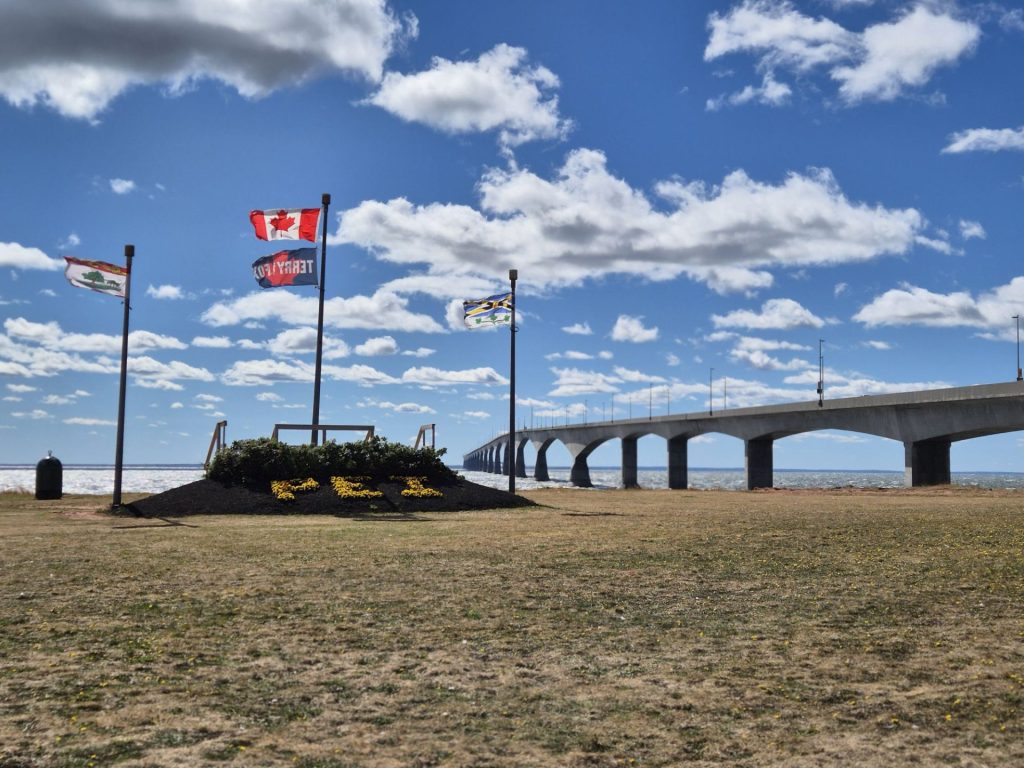
Prince Edward Island is, as we discovered, a very seasonal place. A huge amount of things close down after Labour Day when colleges and universities start again. There are two ways to get onto the island, ferry and bridge – we chose the 8 mile Confederation Bridge, which costs $20, payable on the way back to the mainland.
Confederation Bridge
We stayed in Summerside for 3 days to explore the west side of the island, then 3 days in Charlottetown to do the east. The island is famous for its potatoes (it was harvest time during our visit) and for lobster. There are three marked road trails around the island and we did bits of all of them, driving around tiny lanes, through mainly flatish countryside, found some historical planes for Andy at the Summerside Memorial Park (an Airforce base until the mid 1980s), spotted lots of lighthouses
Point Prim, oldest lighthouse on PEI
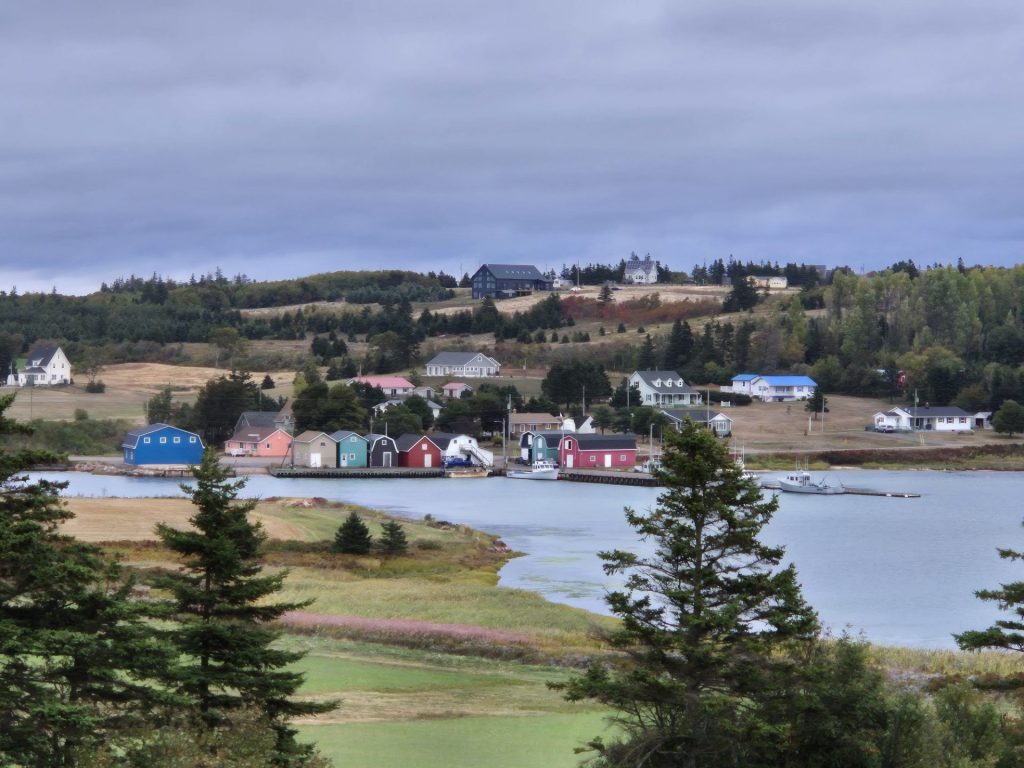
and pretty harbours,
red sandy beaches and white sandy beaches, watched two tides collide at North Cape,
Lighthouse at North Cape2km rock Reef that you can walk on when the tides are out.
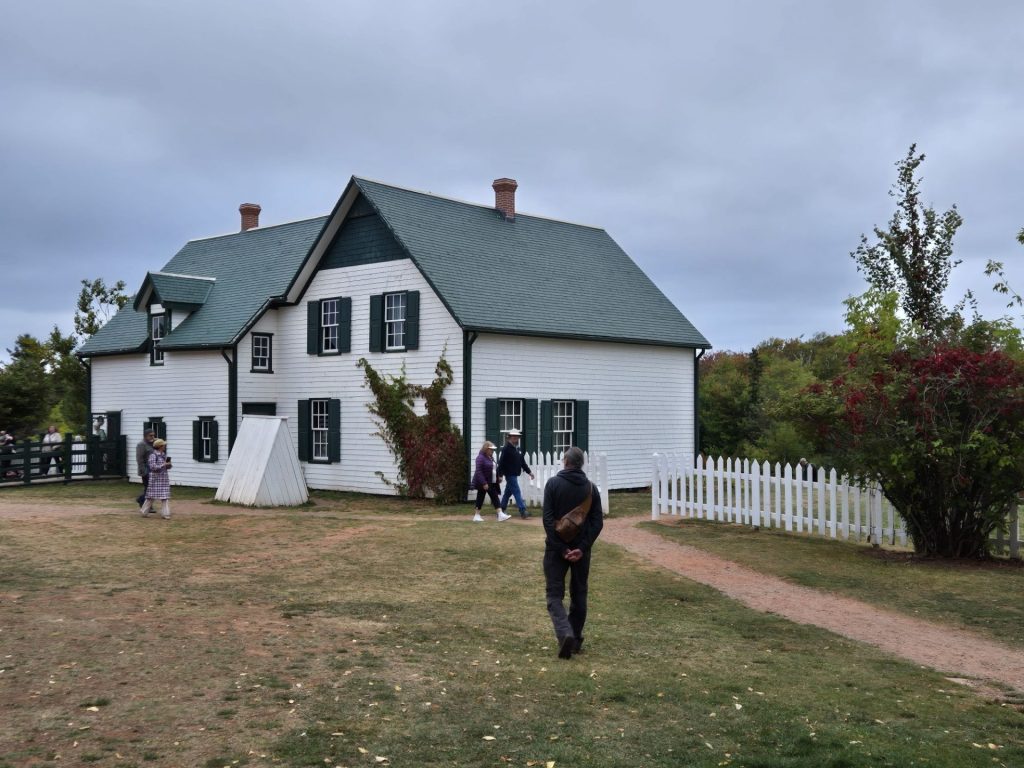
saw cruise ships in Charlottetown, Anne of Green Gables historical site (there are 3 Anne of Green Gables museums, but we just visited one),
Anne of Green Gables house
Visited the St Dunstan’s Basilica in Charlottetown,
St Dunstan’s BasilicaBeautiful colours through the stained glass windows.
ate lots of fish (the Pilot House, Charlottetown and Evermore Brewery in Summerside were fabulous) and found some local beer too. Whilst probably not our favourite place on our Canadian trip, as it’s rather commercial for our tastes, it had its moments.
Placeswestayed –
Summerside – Loyalist County Inn & Conference Centre
We started with 4 days in Halifax, Nova Scotia in a wonderful AirBnB, whilst sorting out our next couple of weeks (we didn’t plan too far ahead due to the wildfires and not knowing where/what we could do because of the fire and hiking bans in place) and catching up with boring things like laundry! We did get to explore Halifax, walked miles, got soaked in a couple of showers, found a couple of very nice pubs (Quinns Arms and Brown Hound), a fun brewery (Good Robot) and watched a little local cricket at the Halifax Cricket Ground. We thoroughly enjoyed visiting the Citadel
The CitadelThe Citadel
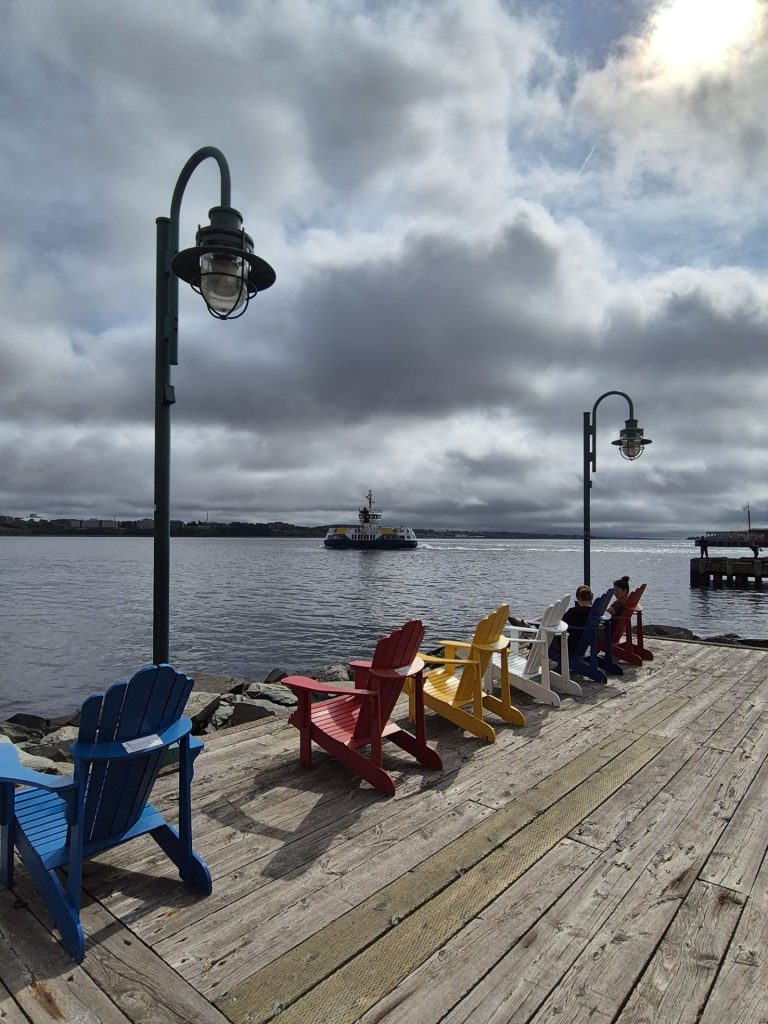
and Maritime Museum of the Atlantic with its excellent exhibitions of the Titanic and the Halifax explosion, as well as the history of many ships of the area, and walking the harbour Boardwalk.
Halifax Boardwalk
There was also a poignant visit to Fairlawn cemetery to pay our respects to 121 victims of the sinking of the Titanic.
Graves of 121 Titanic victims
Then we picked up a hire car for our road trip. First stop was Peggy’s Cove. A gorgeous little fishing village on the south coast, which has managed to remain unspoilt, despite it having one of the most photographed lighthouses (yep, here we go again!) in Canada.
Peggy’s Cove LighthousePeggy’s Cove
We then travelled along the coast, past some stunning little coves to Mahone Bay, where we enjoyed a couple of lovely sunny days. It is famous for its 3 churches view and history of wooden ship building, but unfortunately for us, there was some major road construction going on, so not quite as picturesque as advertised.
3 churches of Mahone Bay
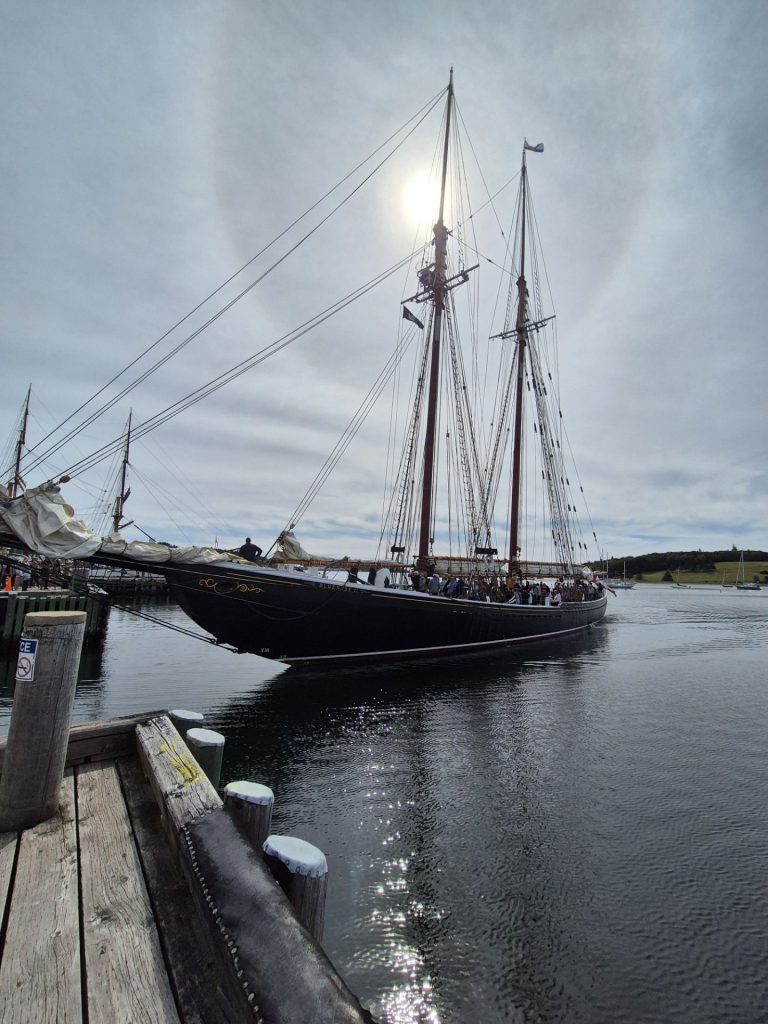
We did spend a day exploring the unspoilt village of Blue Rocks and then the UNESCO town of Lunenburg, where the famous schooner Bluenose II (a replica of the Bluenose, a fishing schooner that won the International Fishing Trophy in 1921) was doing some tours from.
Bluenose II
We saw her in full sail, looking quite majestic, whilst we were driving from Blue Rocks. Lunenburg was busy but we walked miles exploring the streets full of colourful old houses and businesses – the blacksmiths is now a distillery and we found Andy’s idea of heaven – a large wooden boat building shed (he should have been a carpenter).
Old Boat Building Shed, Lunenburg
Sadly, we were unable to visit inside St Andrew’s church, due to a special service, but it does look amazing outside. We enjoyed a delicious seafood chowder at the Fish Shack before returning to our BnB. On Wednesday evenings in the summer Mahone Bay hold free concerts and we managed to catch Freya Milligan doing hers, which was an unexpected surprise and a great way to spend an hour in the evening overlooking the cove.
From Mahone Bay, we made our way up through the middle of Nova Scotia to the Annapolis Valley, via the Greenwood Military Aviation Museum. Annapolis valley is a fertile area and we travelled through lovely rural townships, passed pumpkin fields, apple orchards, vineyards and old Dutch style barns until reaching our destination of the old Nova Scotia Capitol of Annapolis Royal. It is a lovely town to walk around with historic gardens,
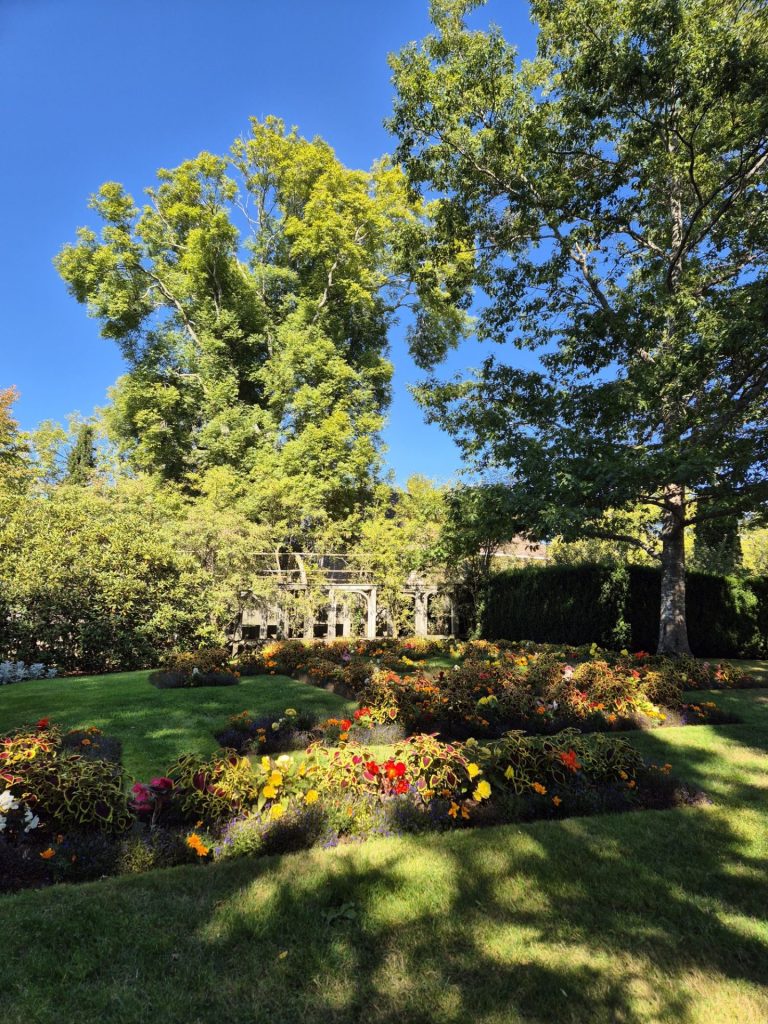
Annapolis Royal historic gardens
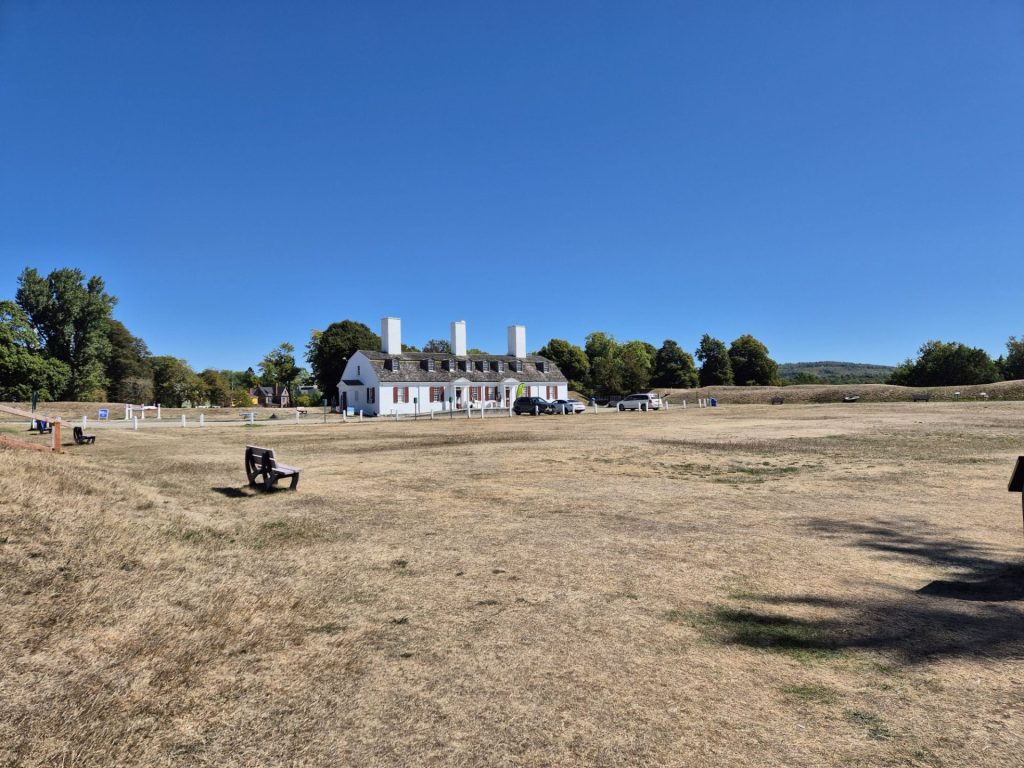
old buildings dating back to the 17th century, Fort Anne (Canada’s first administered national site, fought over by the scottish, french and english over the years),
Fort Anne
a lovely boardwalk and the old wharf all overlooking the stunning annapolis basin (with a tidal range of about 9metres!). The saturday market was excellent, with lots of local produce and crafts.
On the Annapolis Royal boardwalk
On our onward journey we stopped by the very well reconstructed french fort of Port Royal on the other side of the river,
Port Royal
before meandering up the opposite side of the valley, to Wolfville (couldn’t find any parking so didn’t stop here) and up around the coast road – now overlooking Canada’s natural wonder – the Bay of Fundy where you could see some of the world’s highest tides (up to 16metres, depending on the position of the moon). We stopped off in Walton to see the lighthouse that has been moved due to coastal erosion.
Walton Lighthouse moved from where the pagoda is!
The area used to be busy due to it having the world’s largest barite deposit and was mined until the late 70s. Then it was on to Truro for the night. Apparently, you can see the tidal bore in several spots in Truro and even “ride” it in inflatable boats, although our timing was off, so nothing to see!
From Truro, we headed up to Cape Breton. We crossed the Canso Causeway, stopped at the Information centre for some tips on the area, then did a quick trip around the lovely Isle Madame and up to St Peters for lunch, just to catch the tail end of their Pirates Day celebrations. We missed the parade but there were some great decorations.
St Peters Pirate Day decorations
Then up along the edge of the huge Bras d’Or lake and on to Sydney, where we did something we’ve never done in all our years of travelling – check in to a hotel and after seeing our room, check straight back out again!! After a quick panic and internet search, luckily, Erin and Babu at the Simon Hotel came to our rescue and found us a couple of rooms for the next 3 days and rescued our stay.
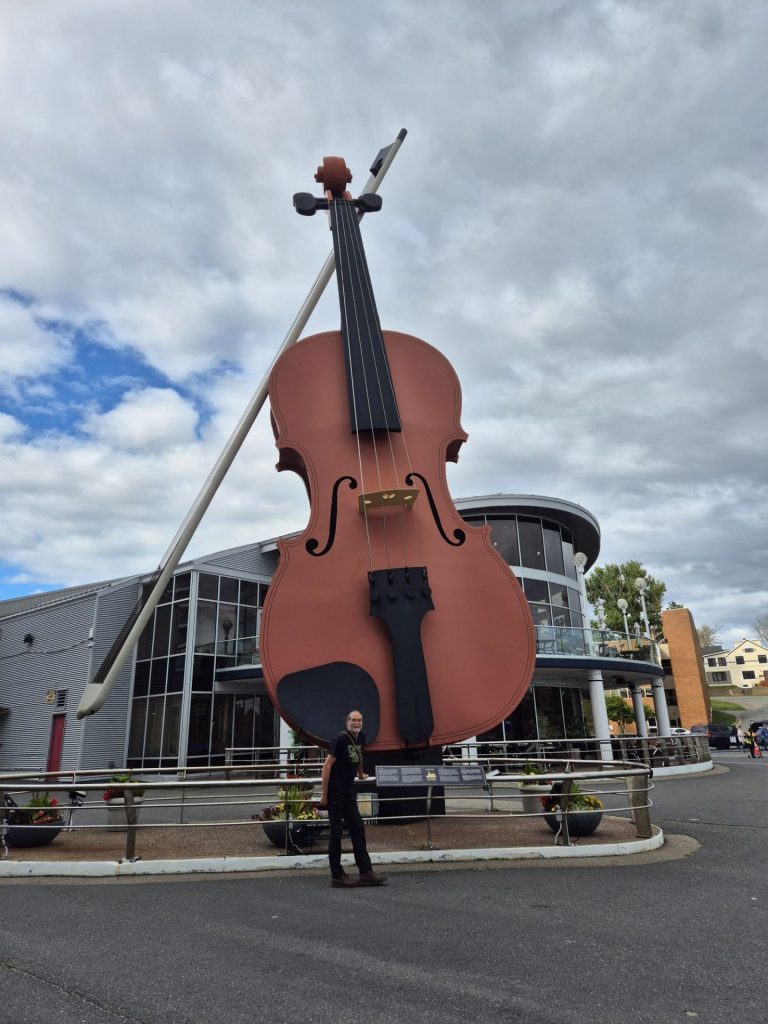
Sydney is a nice little town where the cruise ships come in (there was 5 in the 3 days we were there as September is a busy month for them) and home to the Big Fiddle (17 metres high and weighs 8 tons).
The Big Fiddle, Sydney
Lots of little eateries, a really good cider house (Island Folk), pleasant boardwalk to meander along the harbour, and just generally a good place to chill. We took a day to see the Fortress of Louisburg national historic site – well worth a visit but be prepared to take a few hours to do this. 20% of the original site has been reconstructed in the 18th century period using archaeological digs and historical records from France and Canada. The staff are very knowledgeable and are in costume, there are various tours you can do or just explore on your own.
Fortress of Louisburg Musket firing demonstration
On the way back, we had, of course, to pop by and see the Louisburg lighthouse – built on the ruins of the first lighthouse erected in Canada.
Louisburg Lighthouse
We left Sydney to head towards the Cape Breton highlight – the Cabot Trail, described as one of the world’s most beautiful drives. We stopped in the pretty lakeside town of Baddeck for lunch before getting up to Ingonish Beach for the night.
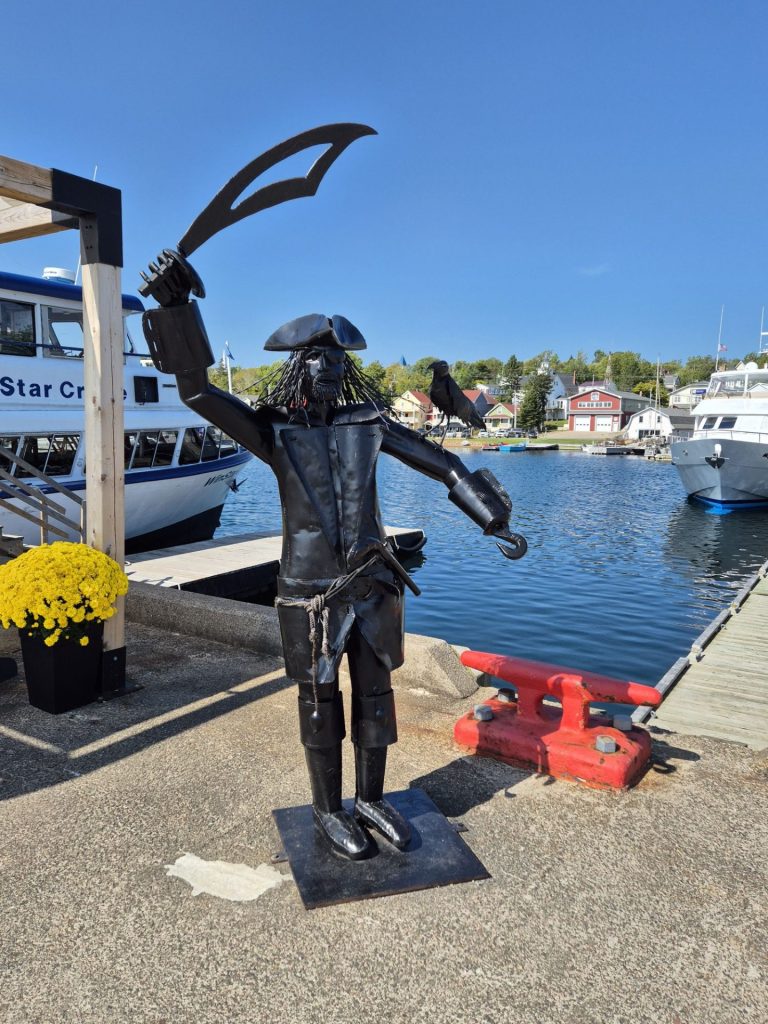
Baddeck – Yes, the lake has a lighthouse, too!Baddeck – and a pirate!!Ingonish Beach
The next day, with park pass in hand, we entered the national park. As we had entered the park at the furthest point from the Skytrail, we decided just to bimble our way around, stopping off at little places like Neil’s Harbour,
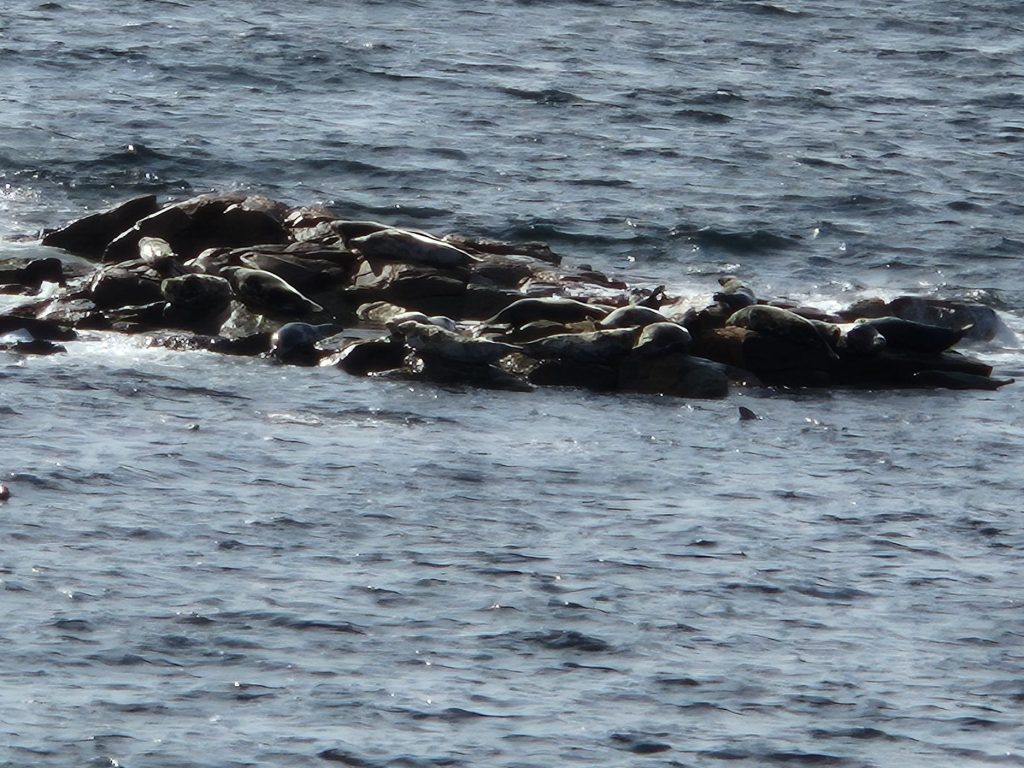
Neil’s HarbourSeals off Green Cove
White Point and Dingwall. Funnily enough, there’s a lighthouse at Dingwall (!) – St Pauls, which has come from St Pauls Island (known as the Graveyard of the Gulf due to the number of shipwrecks around it). Katie gave us a tour of the tiny but very interesting museum here.
The old St Pauls lighthouse at Dingwall
We also did some of the shorter hikes and, of course, stopped off at the many lookouts to admire the scenery. The Skytrail was open again (it closes once the carpark is full and fills up quickly in the mornings) when we got there but the weather had closed in and rain was due so we decided to miss this.
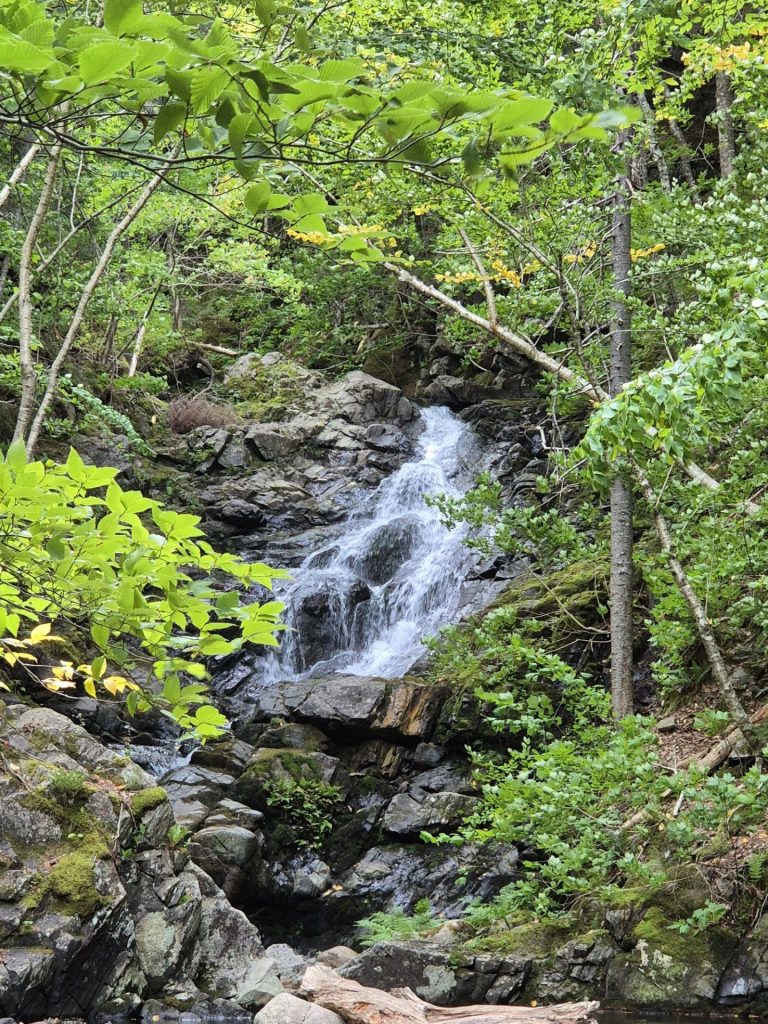
The Great Aspy FaultThe Cabot TrailSmall waterfall on one of our short hikes
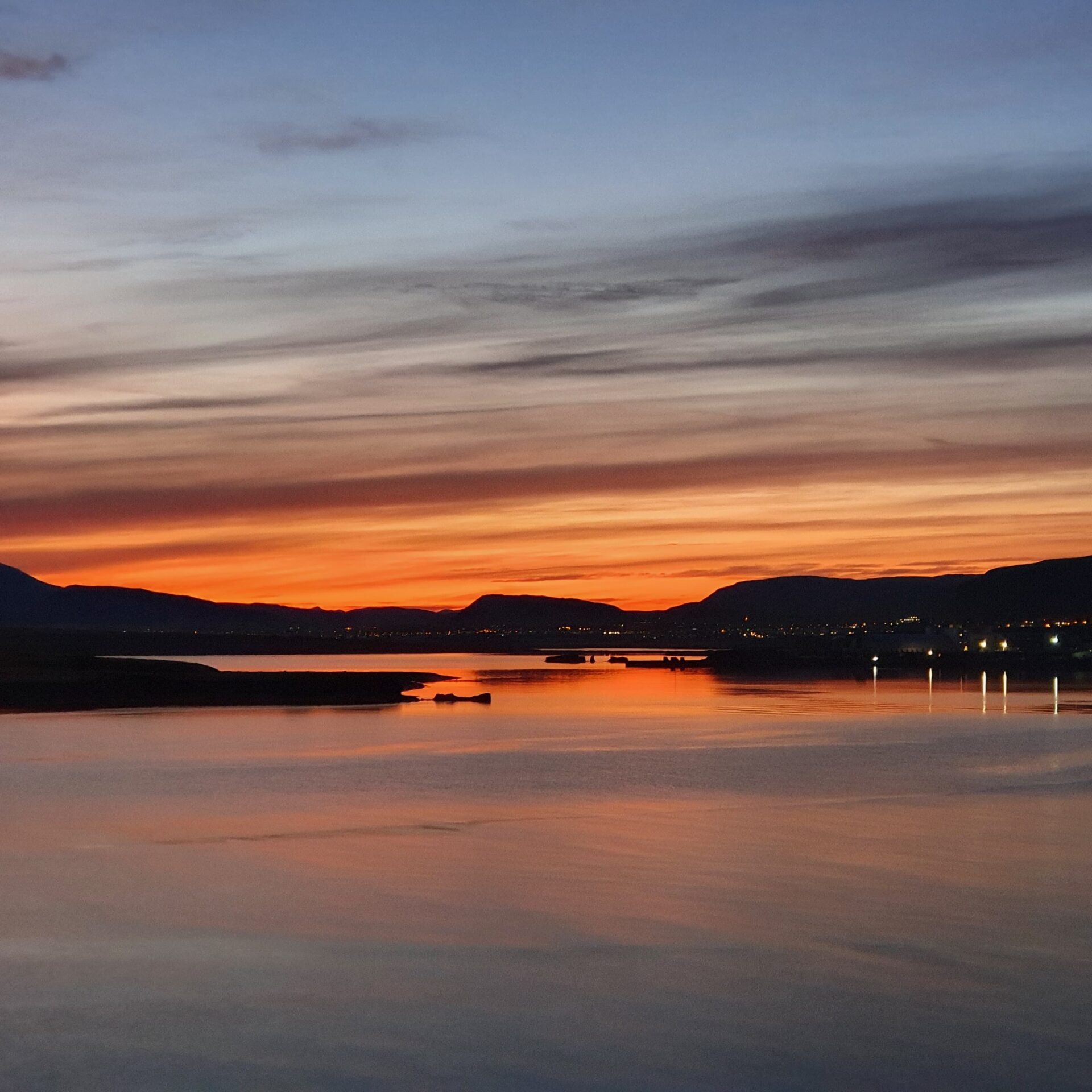
We ended our long day in Port Hood (the beach capital of Cape Breton with 5 beaches) with a beautiful crimson sunset.
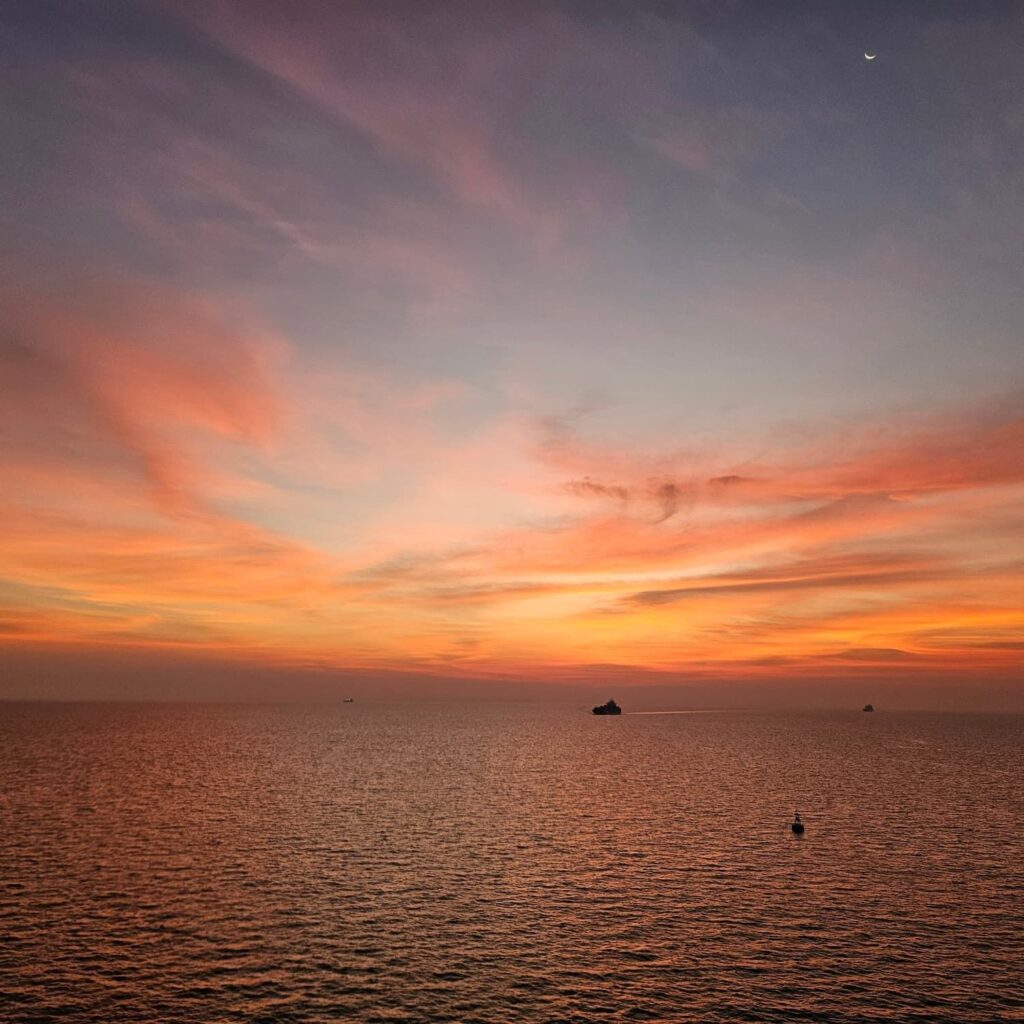
Sunset at Port Hood
The Cabot Trail is definitely worth the trip, even if you don’t hike any trails. Oh, and photos will not do what you have seen justice!
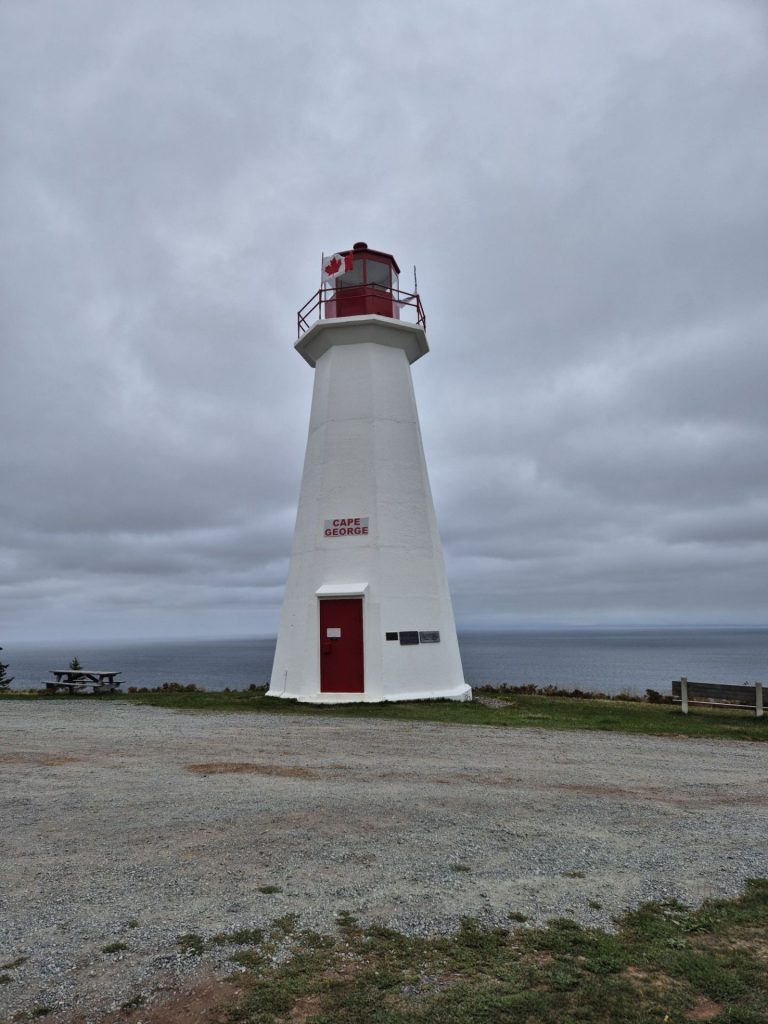
Our final day in Nova Scotia saw us leave Cape Breton and head to Tatamagouche – just because we liked the name! We went via Cape George and the sunrise trail but the weather closed in again so we didn’t get to see much (other than the Cape George and Arisaig Lighthouses, both cared for by the local communities now).
Cape George lighthouseArisaig lighthouse
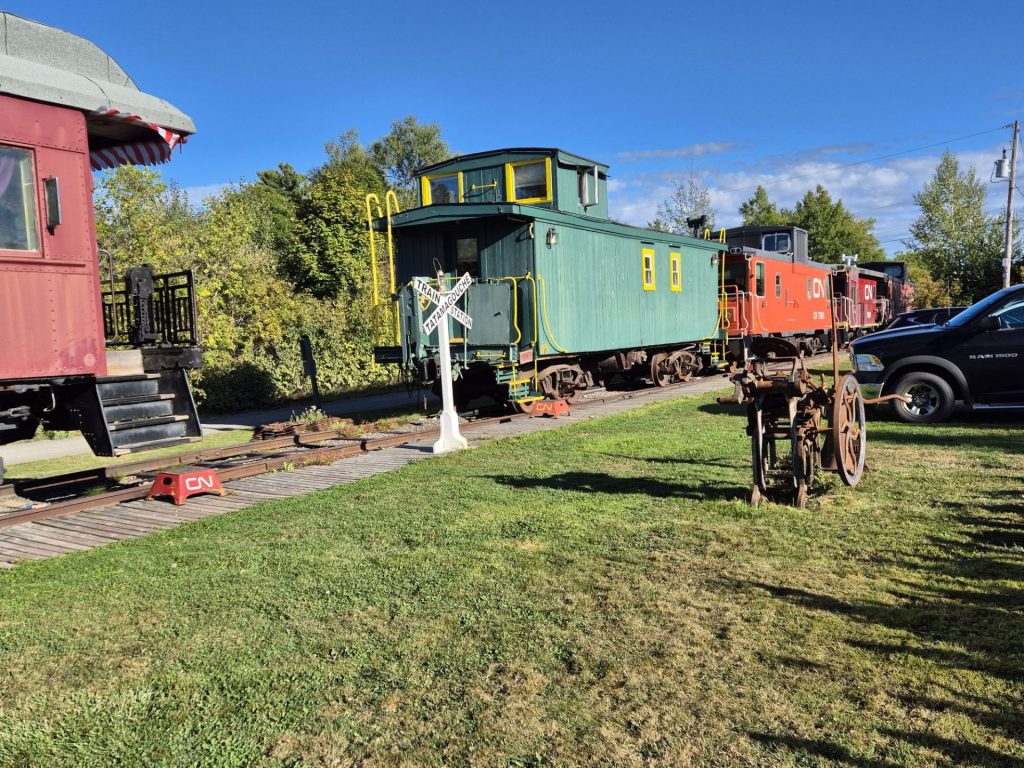
Sadly we couldn’t get into the Tatamagouche Railway Inn, where you can stay in a train carriage
Carriages at Tatamagouche Railway InnHippie Dippie beer
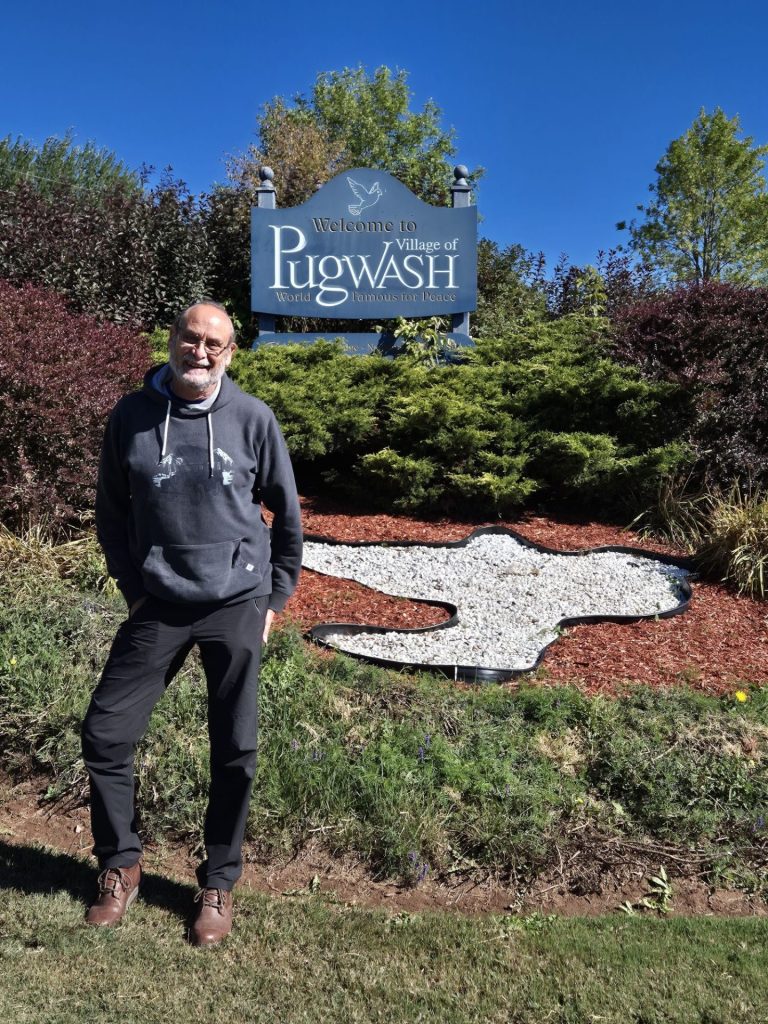
but we did manage a couple of “Hippie Dippies’ in the Tatamagouche Brewery (good music too) and a tasty seafood chowder in the Chowder House. Next day we meandered the tiny back roads, via Fox Harbour and Pugwash (Andy had to have a photo at the sign but no Captain to be found!)
Pugwash
and stopped at a couple of local markets before finally, and sadly, leaving Nova Scotia.
We enjoyed our 17 days in Nova Scotia – a trip that was a little more loosely planned than usual, due to restrictions from fire and hiking bans in places, but we still managed to see a wide variety of places, met lovely people, learnt a lot of the local history, ate a lot of fresh fish, drank some good local ales and ciders and even had great weather until the last couple of days!
We flew into St John’s Newfoundland, via a direct flight from Gatwick and stayed for a couple of days to find our feet. Public transport is not so prevalent but St John’s is quite walkable, albeit, hilly! We arrived in the middle of the Canada games and also an Arts Festival, so it was quite busy.
First day and the heavens opened, bringing much needed rain to St John’s, but it didn’t put us off! We managed to spot the Jelly Bean houses (even the mailboxes and a bird box were coloured!),
Even the birdboxes are colourful!
visit the war memorial,
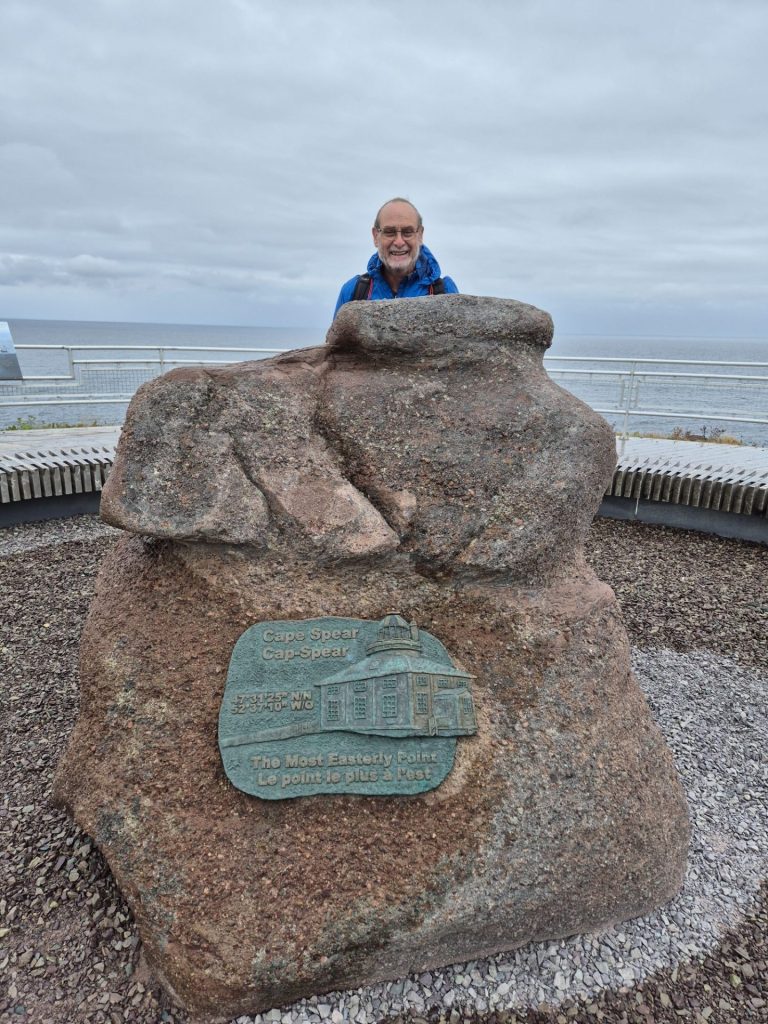
get some great tips for our road trip from Monet at the information centre and do a tour on the 10 stop Hop On Hop Off bus. We did get off at Cape Spear – the most easterly mainland point of Canada,
The most easterly point marker
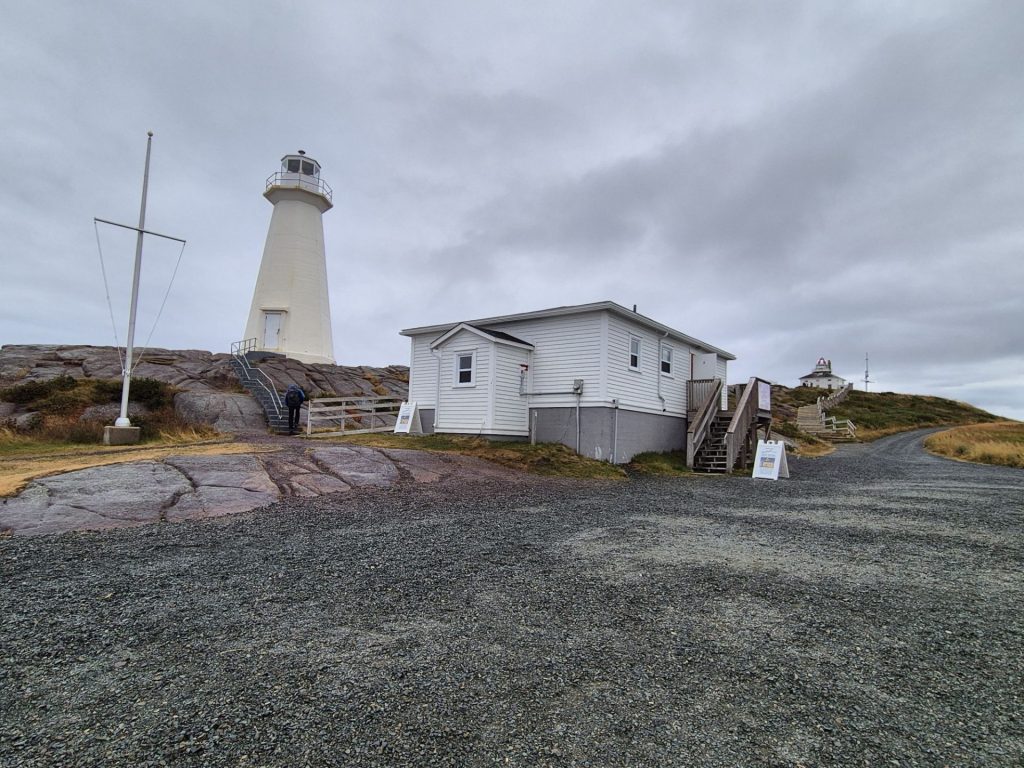
home of 2 lighthouses (the old one is the oldest surviving in Newfoundland and was manned by members of the same family for over 100 years) and also has some second world war fortifications. It’s a beautiful spot, even in the rain.
The “new” lighthouse at Cape Spear
The next day, the skies cleared, so we got the bus to Signal Hill visitor centre, then walked up the hill via Queens Battery and up to the Cabot Tower
Cabot Tower
where Marconi received the 1st transoceanic wireless signal. The views over St John’s are fabulous.
View over St John’s Harbour
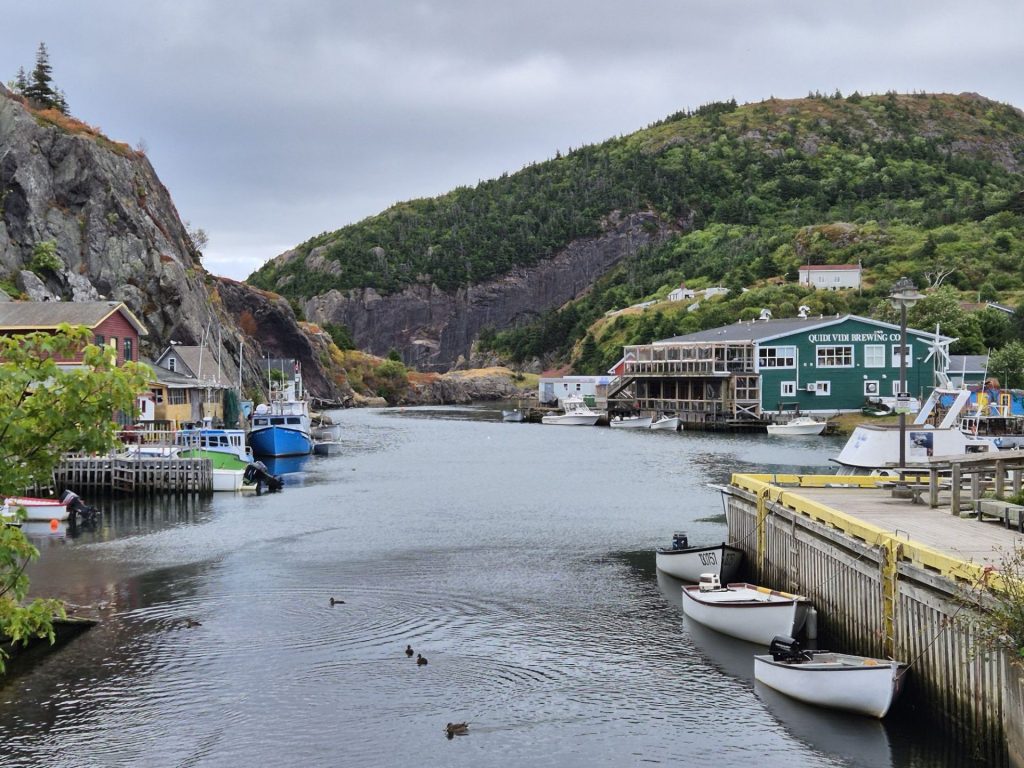
Then, off down the trail to Quidi Vidi, a fishing village (you can go cod jigging here!), which funnily enough also has a good brewery!!!!
Quidi VidiQuidi Vidi
We finished the day back in downtown with a quick trip to see the last train in Newfoundland (no trains running anymore)
and accidently came across the historic Newman Wine Vaults, one of the oldest structures in St John’s and where you can learn about the link between Portugal, England, and Newfoundland (Newmans Port).
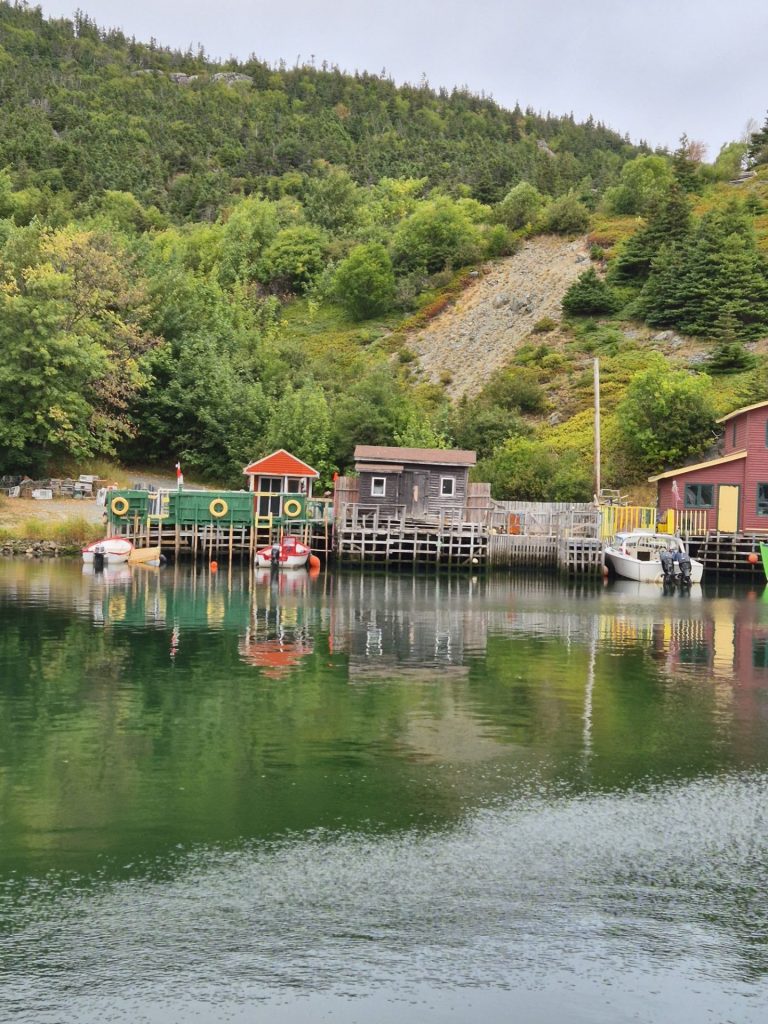
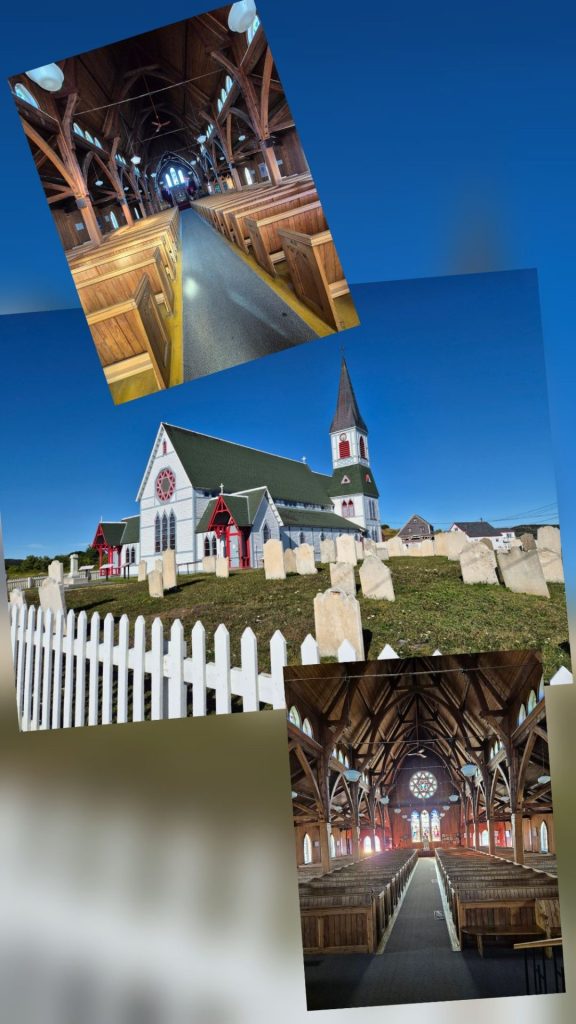
The next day the sun came out and we picked up our hire car to start our road trip. We headed up to the Bonavista Peninsula for a 2 night stay in the lovely old fishing village of Trinity – beautiful traditional, colourful wooden houses overlooking the bay with Fort Point lighthouse in the distance.
Trinity ChurchFort Point lighthouse
Hurricane Erin then brought in some rough winds, grey skies and a drop in temperature so the woolly hats and coats came out and we headed to the tip of the Peninsula. First stop was Elliston, root cellar of the world! There are loads of root cellars here, built into the ground to store all the root vegetables!
Root cellar
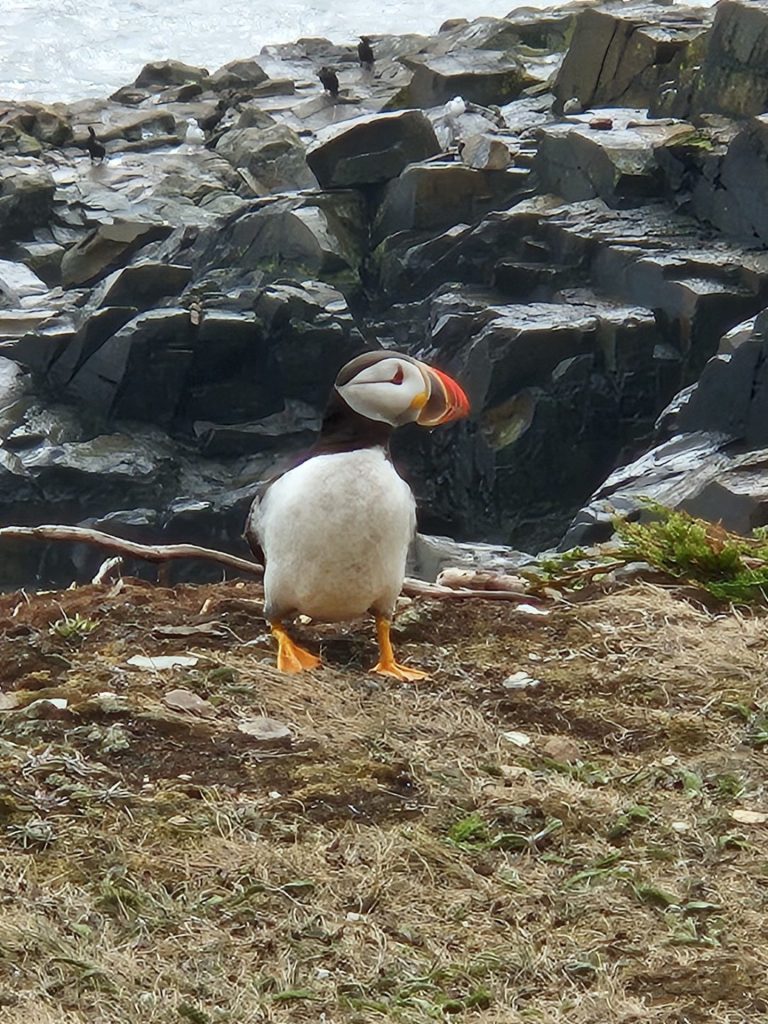
However, there is also a puffin viewing spot here and oh we were so lucky to see not just hundreds over on an island but a handful close up where we were standing – such a very special moment. Then we headed up to Bonavista Lighthouse and the spot where John Cabot made landfall in 1497. Spotted more puffins in the distance and seemingly they will leave in the next week to float around the sea until they return next year to mate.
From Trinity we had a long road trip up the road to the islands (once off the Trans Canada Highway the roads can be a bit rough) to Twillingate. Near the top the road literally joins several islands together via bridges and causeways. We arrived just in time to have the last seats at the Twillingate dinner theatre and enjoyed a good meal, excellent company and an hilarious show – Newfoundland music and skits. Just what was needed after the long trek up. Next we visited Long Point lighthouse at Crow Head. The keepers had to wind a 50lb weight every hour for the light to turn!! It’s automated now.
Long Point lighthouseThe weight that used to be wound every hour.
Our next stop was Rocky Harbour. Another long road trip, which should have been through some stunning scenary but sadly it was covered in smoke from the Nova Scotia wildfires 🙁 Rocky Harbour is within the Gros Morne National Park. Another lighthouse (Lobster Cove) with a very well presented history of what life was like there.
Twillingate – Harbour Lights Inn
Lobster Cove lighthouse
Then, on up the coast, this time with the sun shining, so we could see the Long Range Mountains and another couple of lighthouses (bit of a trend here!) – the smallest one we’ve seen so far was at Cow Head
Cow Head lighthouse
and then on to the Point Riche lighthouse at Port au Choix where we stayed over night.
On our journey up we stopped at the wreck of the SS Ethie
SS Ethie wreck
and the Arches Provincial Park, where 3 rock arches rise out of the beach!
Arches Provincial ParkPointe Riche lighthouse
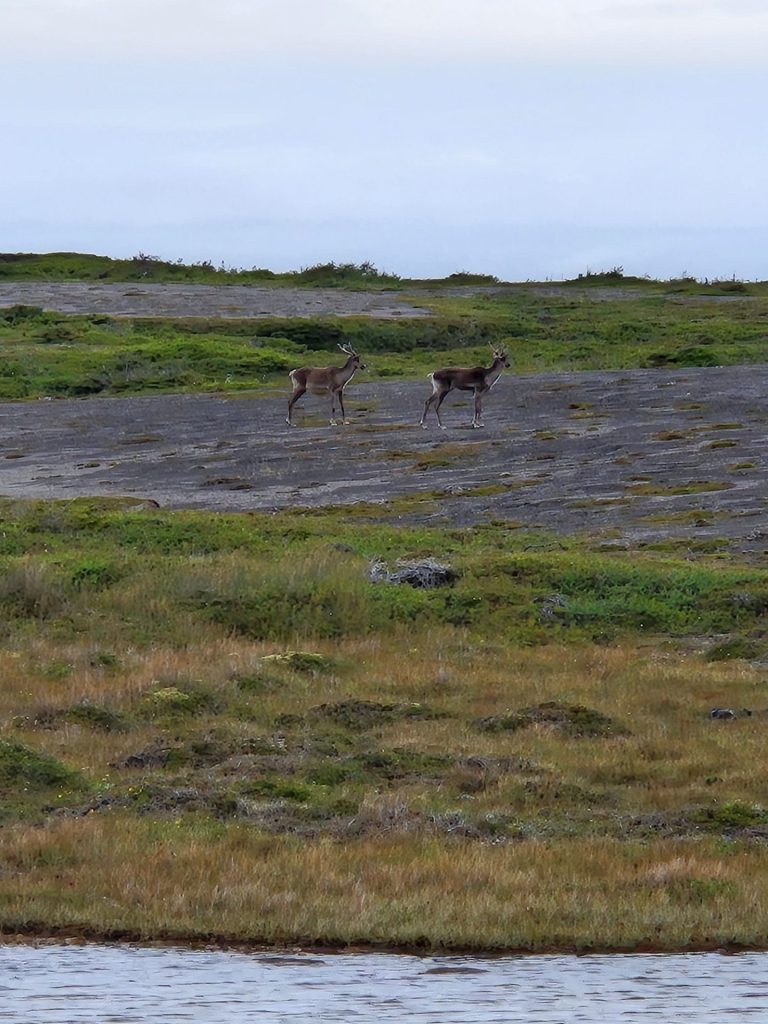
Temperatures again hot erratic from 24 degrees and sunny one day to 10 degrees and raining the next! We managed to catch sight of a small herd of Caribou before heading north.
Caribou
We cut inland along the Grenfell trail – lovely scenary (between the showers), Andy spotted a moose but it had gone by the time I lifted the camera and the sun managed to come out when we arrived in St Anthony. We took a short trip up to – you’ve guessed it – Fox Point lighthouse, quite a short squat one this time with beautiful views across the bay.
Fox Point Lighthouse
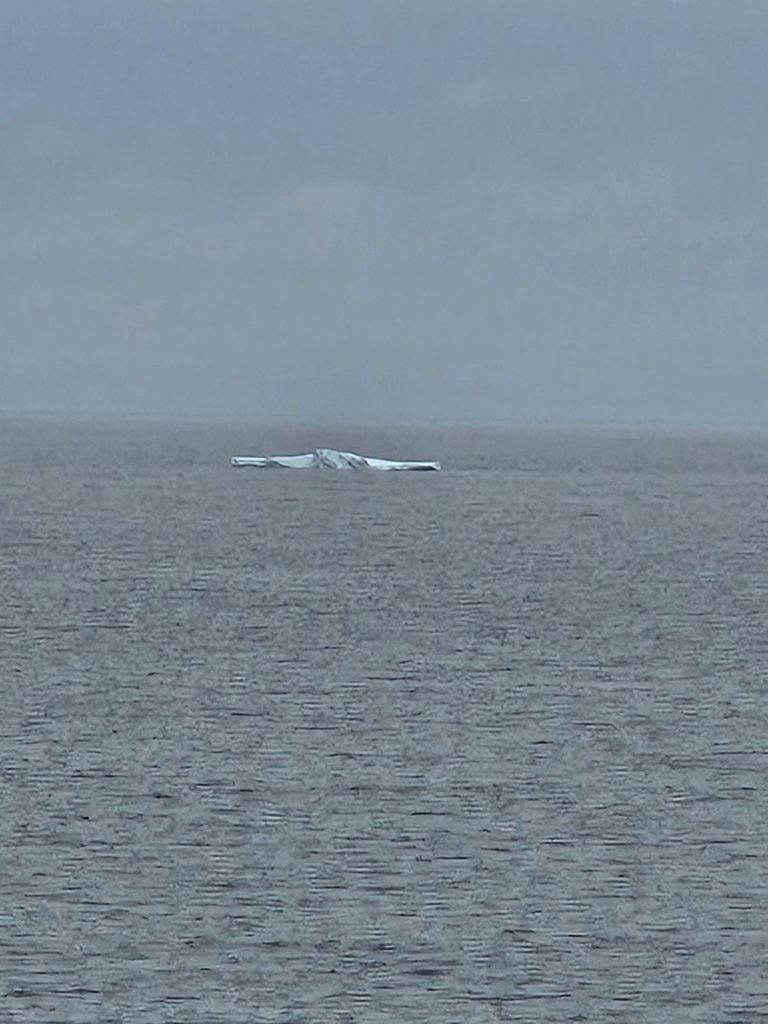
And………there was an iceberg – ok a small one compared to the giants they get here but as it is very late in the season we didn’t expect to see any at all.
Iceberg!
We then had a lovely dinner at the Lighthouse Cafe, and lo and behold, we spotted 2 whales playing in the bay. What a wonderful way to end our 43rd anniversary.
The temperature rose again to 24 degrees and we had sunshine and clear blue skies in St Anthony – a perfect day for driving through tiny coastal villages on the way to L’Anse aux Meadows, an historic site where an excavated 11th Century Viking settlement can be viewed. There is an interesting reconstruction of sod buildings here and you can see some of the current excavation teams still working.
Reconstructed sod buildings
We also did the beautiful Birchy Nuddick trail here spotting partridgeberry and squashberry plants along the way. Our hostess in Port au Choix made delicious jams from these berries so it was lovely to see them in the wild. On our way back we stopped to try moose burgers – rather nice actually, before heading back to the lighthouse to see if there were any more whales. Sadly, none, but the iceberg had moved into the bay area, tipped over and the locals think it has grounded as it hadn’t moved since the morning! Finally, we popped into a tiny museum in the gift shop which provided an interesting display of life on the northern penninsula of Newfoundland including the wildlife (including a polar bear), the tradition of mummering at Christmas, what happened during the resettlement years, and explaining the tiny roadside vegetable patches that we have seen along our journey.
St Anthony
Then we started our way back down to Rocky Harbour, this time via the Viking Trail that hugs the coastline. It was a clear day so we could see the coast of Labrador across the Gulf of St Lawrence. We stopped off at Flowers Cove to see the thrombolites as we’d seen some in Western Australia – the ones here are huge in comparison!
Thrombolites
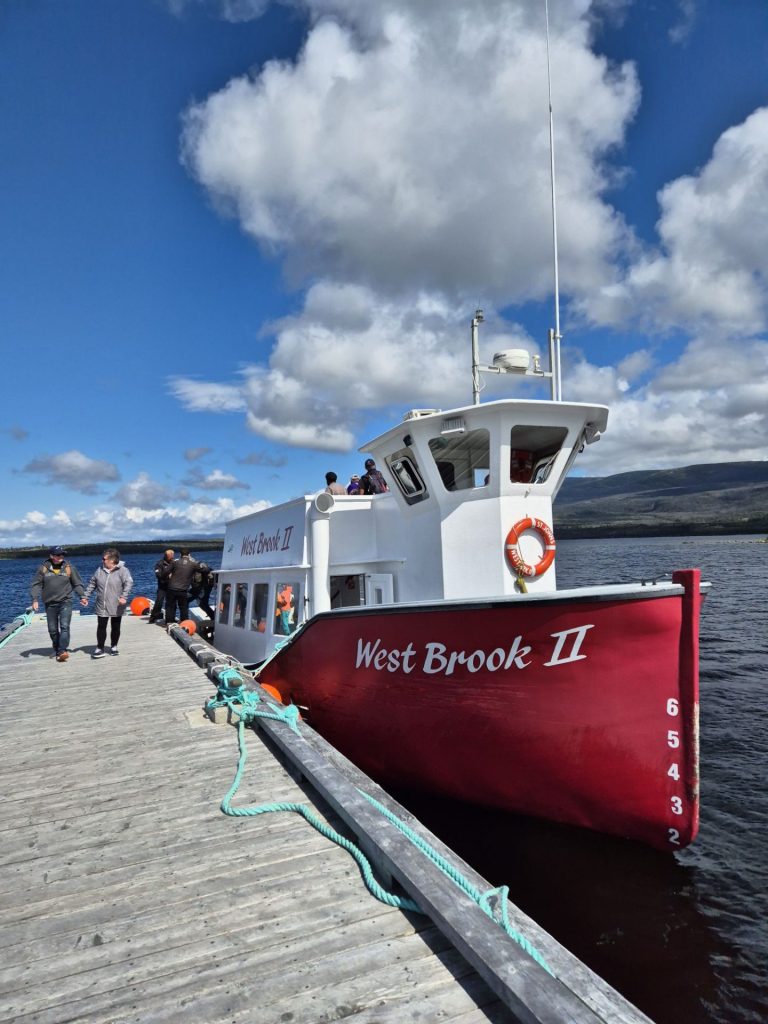
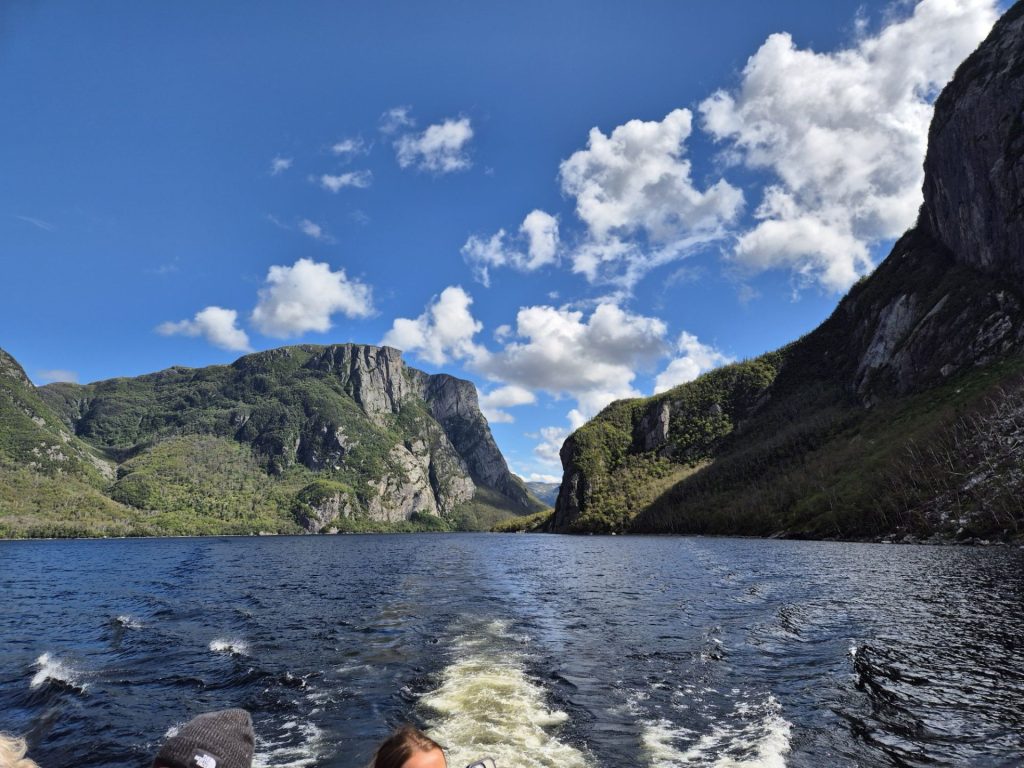
Anyway, the reason we came back to Rocky Harbour was to do the Western Brook Pond boat trip in the Gros Morne National Park – and boy, we were so glad we did. The sun was out so we had clear views of the stunning Long Range Mountains. Western Brook Pond was a fjord many years ago but is now landlocked and even though it is 16km long and 165 metres deep it is called a Pond! There are thousands of “ponds” across the Rock (Newfoundland), some are called ponds, others lakes but we’ve not got to the bottom of which is which – size doesn’t seem to come into it. The boat trip took about 2 hours and we even dropped 2 hikers off at one end to start a 4 day hike (with a permit and a guide only)! Brad, Jamie and Chris on our Bontours boat were very entertaining and informative and we’d definitely recommend this trip. There’s a 2.7km flat walk to get to the boat but you can pay for a golf buggy to take you there as well. We finished the day off with a lovely meal at the Buoy and Arrow before repacking for another long drive in the morning.
Western Brook Pond
On Labour Day we set off on our way back to St John’s. The sky was clear so we got to see the stunning scenary through Gros Morne on the road back to the Trans Canada Highway – you could even see the Tablelands in the distance – one of the few places on earth where you can see the earth’s mantle.
Tablelands in the distance
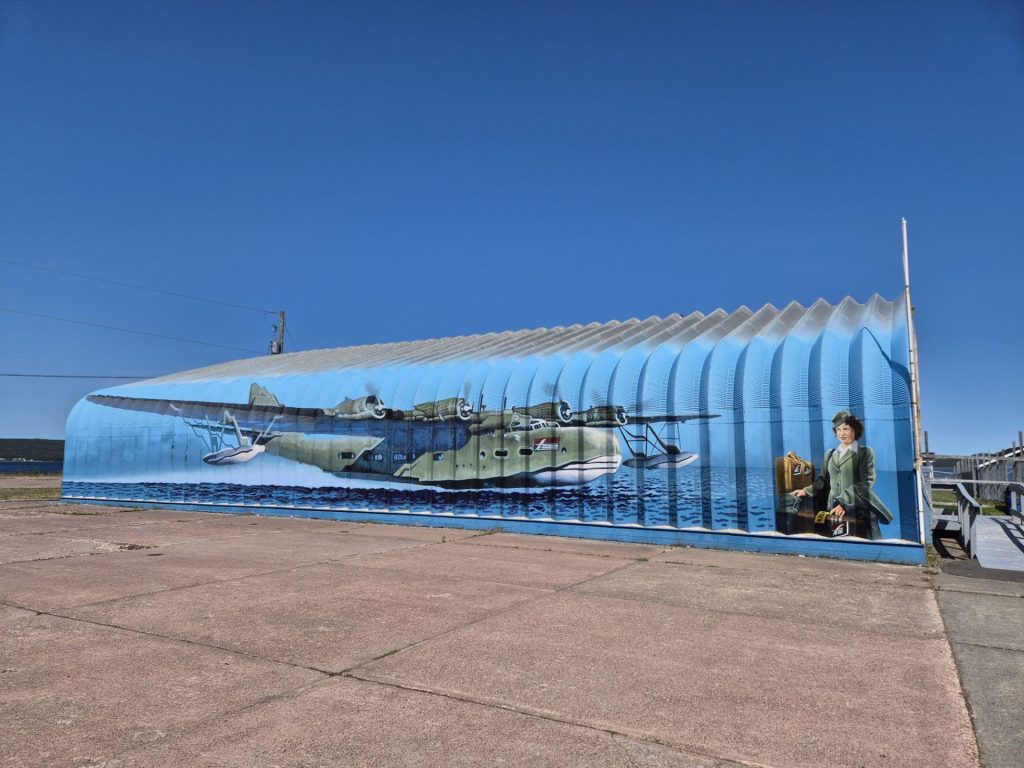
We didn’t see any of this on our way up due to heavy smoke from the Nova Scotia wildfires. We stopped off at the little town of Botwood to see if the Flying Boat Museum was open, but sadly, for Andy, it was closed.
Mural on the Flying Boat Museum
The town has some lovely murals, though, and we also learnt about the Killick anchor. It’s like a basket with a weight/stone in, and the bottom has spikes on and is useful if there is nothing for a conventional anchor to “dig” into.
Killick Anchor
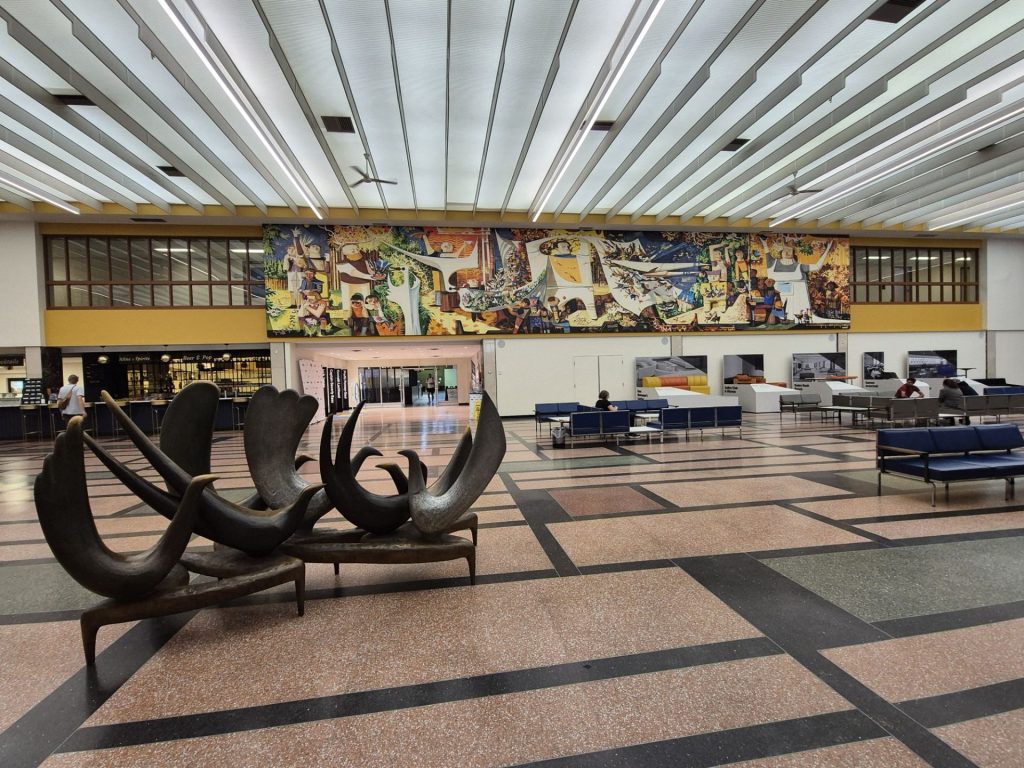
Then it was on to Gander, where we stopped for a couple of nights. Gander has a fascinating history, oh, and is home to the North Atlantic Aviation Museum, so Andy got to see his planes!!! There is also a fascinating exhibition in the International Lounge of Gander Airport – from its history during World War 2, to it becoming the “Gateway to the World” and it’s famous visitors during the golden age of aviation, to its amazing feat on Sept 11th 2001, landing 38 planes and the area looking after 7000 passengers! Depicted in the musical “Come from Away”, which sadly we missed by a couple of days.
Iconic lounge at Gander airport
We also popped down to Gander Lake to see the Silent Witness memorial for the Arrow Air flight 1285R crash, the worst on canadian soil, and also paid our respects at the Commonwealth War Graves.
Silent Witness Memorial
Our final day saw us back on the TCH 1 back to St John’s. We did have a little side trip to ….Dildo! Fascinated as to how a village got this name, we decided to investigate. It’s a pretty village on Trinity Bay, and thanks to the townfolk and their Mayor, it has a hollywoodesque sign on the hillside!
Dildo donkey weather forecast
There are various theories as to how the name originated:-
An aboriginal name for ‘still waters’
An adaptation of Portuguese, Spanish or French word meaning ‘delightful’ or ‘two islands’
But the one we liked was a local legend that states one local fisherman asked his friend, “how about this harbour for shelter from the storm?” to which his friend replied “twill do” or “dil do” and from this came the name Dildo!
From there, we returned to St John’s to find 2 huge cruise ships docked! So much for a quiet drink and final explore, but we did make it back in time for Happy Hour at Yellow Belly Brewery!!
And so we say farewell to Newfoundland.
We’ve travelled 2902kms (1803 miles), experienced very varied weather, driven long distances on some rickety roads, met the most friendliest of “Newfies” – all wanting to know about us and offer little snippets of local information for our trip, seen lovely scenary and wildlife but have got a bit fed up with fish and fried foods!! Oh, and we managed to miss the “Screeched In” ceremony! We’ll miss the lovely lilt of the Newfoundland accent, a sort of gaelic, canadian mixture with some cracking sayings. Now on to the next leg of our adventure…..
Wherewestayed
StJohn’s – Murray Premises Hotel (an old converted fish processing building)
Trinity – Rosewood Suites
Rocky Harbour – Wildflowers Inn & then Stay at Gros Morne
Port au Choix – Jeanne’s sunrise B&B (fabulous homemade jams)
StAnthony – Grenfell Heritage Hotel (old nurses residence)
And so sadly, our 380-day adventure has drawn to a close. We’ve been lucky enough to visit 14 countries, travelling by plane, seaplane, motorhome/campervan, hirecars, taxis, ubers, trains, cruise ships, ferries, staying in 81 hotels/motels/AirBnBs, 2 cruise ships, 1 train and 26 campsites and walking our feet off having the most amazing time. We’ve seen stunning scenary, beautiful architecture, wonderful animals in the wild, observed the highs and lows of peoples lives, heard the phrase “cost of living crisis” in every country we visited, witnessed the mighty power of mother nature and met some great people along the way. Now we return, with mixed feelings, to set up home, see what comes next, and reflect on being so lucky to have been able to go on this wonderful adventure.
And if you’re reading this, we’d encourage you to take the plunge too – life is too short, so live it to the full to the best of your abilities.
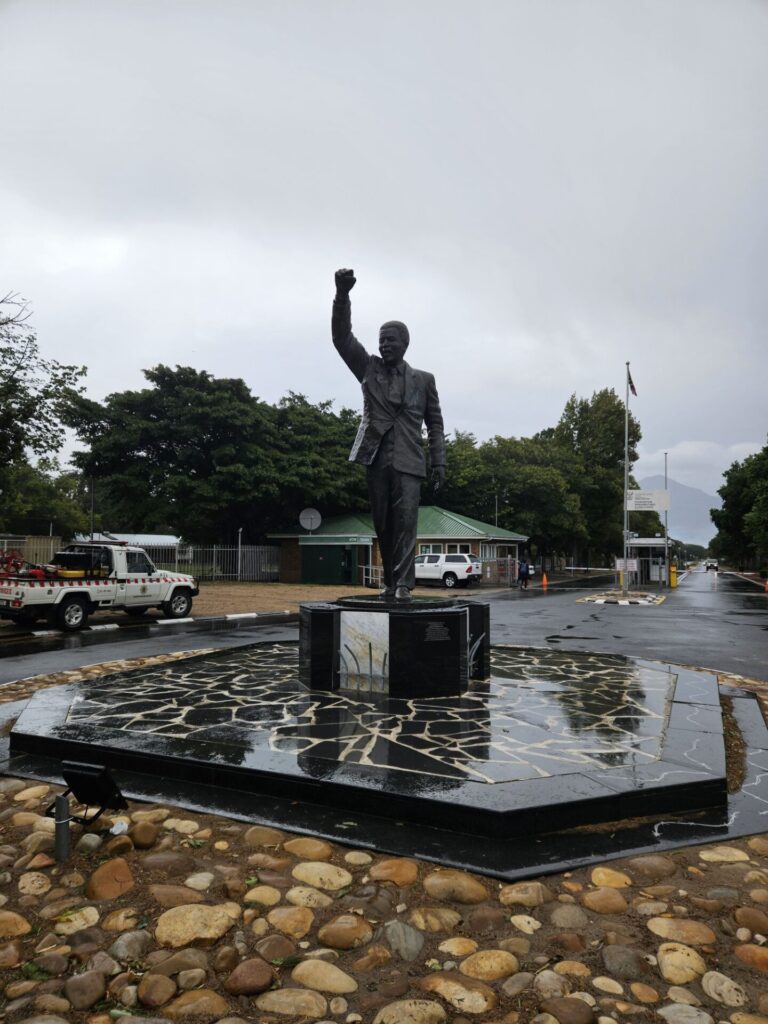
Cape Town – a city where you get 4 seasons in one day and more!!!! The weather was rough when we arrived (hence the ship collision!) and it continued for our first few days. However, there’s lots to do here (and we’ve not done half of it) so we did a winelands trip (in a storm!), did the 2 routes of the Hop On and Off bus which give you great views of the surroundings as well as the city, explored the V&A Waterfront watching the boat repairs in the dry docks, the sailing ships going about their business, the seals having fun chasing the boats, listening to some great music from locals performing in the area, eating some fantastic food in the Time Out market and admiring the creative talents on show in The Watershed (I could have bought it all – if only!) We didn’t get out to Robben Island due to the weather. This is where Nelson Mandela was imprisoned for 18 years, but we did get to see his statue in front of Victor Verster prison, where he was finally released from.
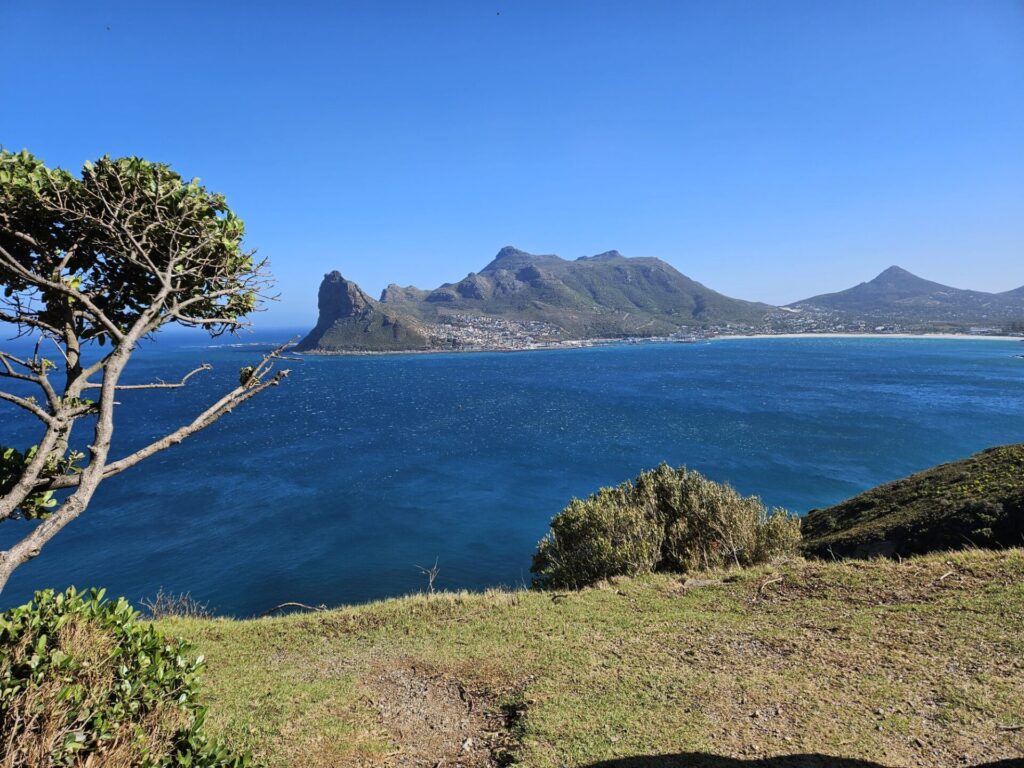
We took a day trip around the Cape Peninsula. There is gorgeous scenery all the way, but especially around Hout Bay and the stunning Chapmans Peak Drive.
On Chapmans Peak Drive looking over Hout Bay
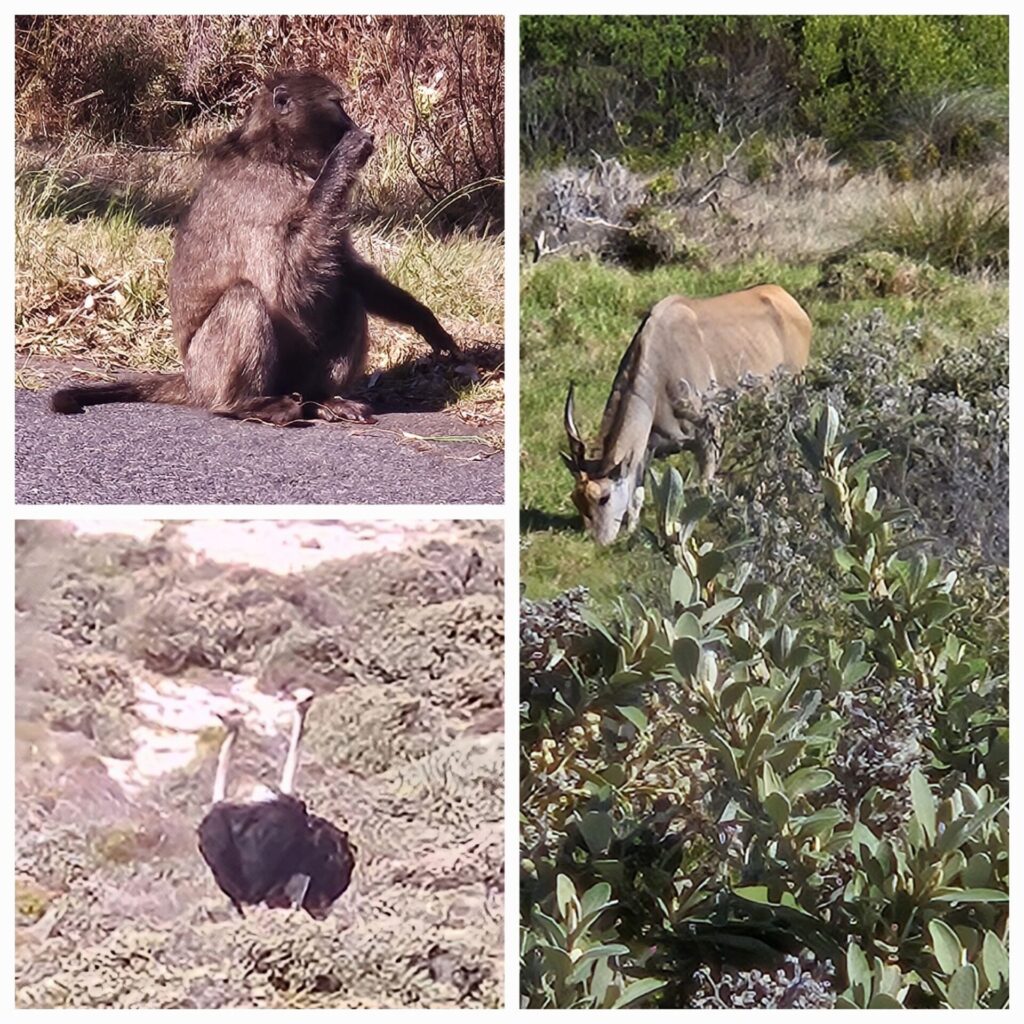
We were lucky enough to spot Ostrich, Eland, and Baboons, too.
Cape wildlife
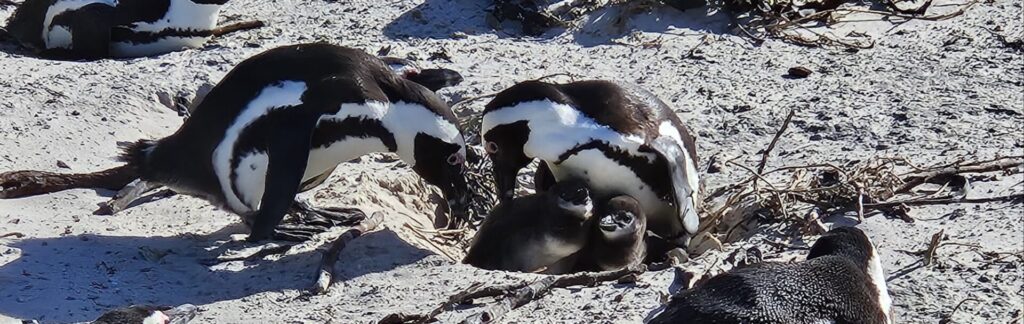
Then we travelled on through the Cape of Good Hope nature reserve, down to Cape Point and the Cape of Good Hope (or Cape of Storms as it was to be named). Then up the other side through Noordhoek with its beautiful wide bay and rolling waves to Simonstown for delicious fish and chips. And finally to Boulders Beach to check out the lovely colony of African penguins that settled here in 1982. There were quite a few chicks to be seen, so it looks like the colony is doing well.
Happy penguin family
This is definitely a trip worth doing.
Then we hired a car for a few days to go out and explore on our own, and our first stop was Stellenbosch – the Village of Oaks. Named so because the streets are lined with oak trees, although they were busy clearing up after the storm damage from the previous week. We enjoyed a walking tour, learnt the dutch put the street names on the kerbs
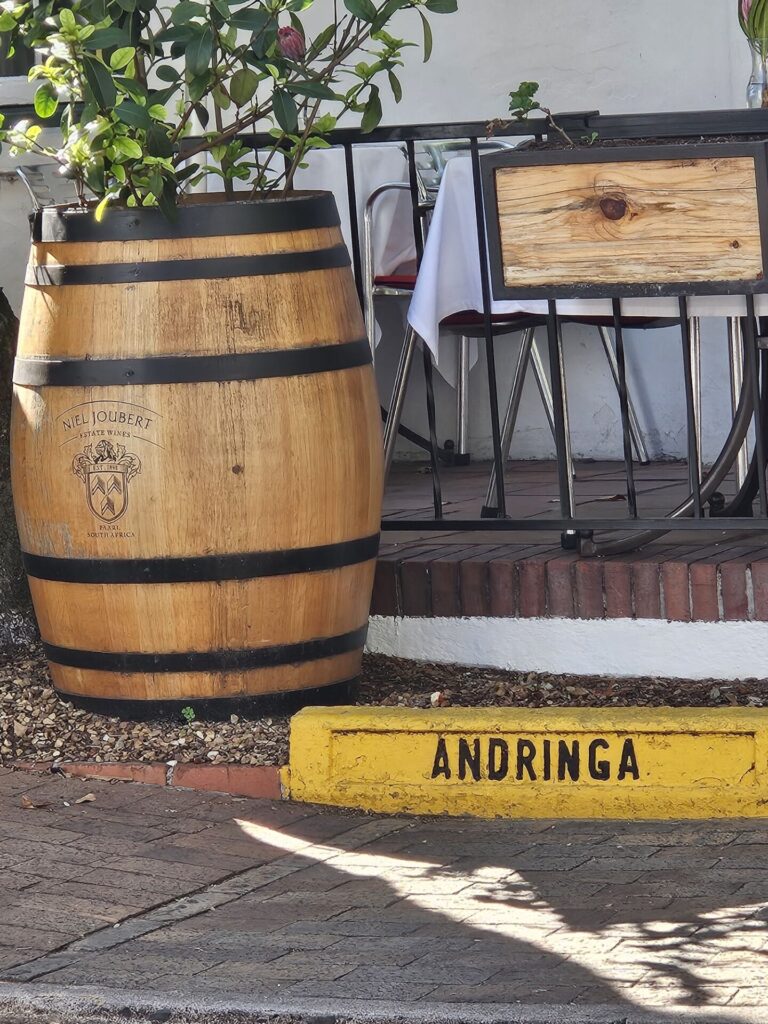
Street sign
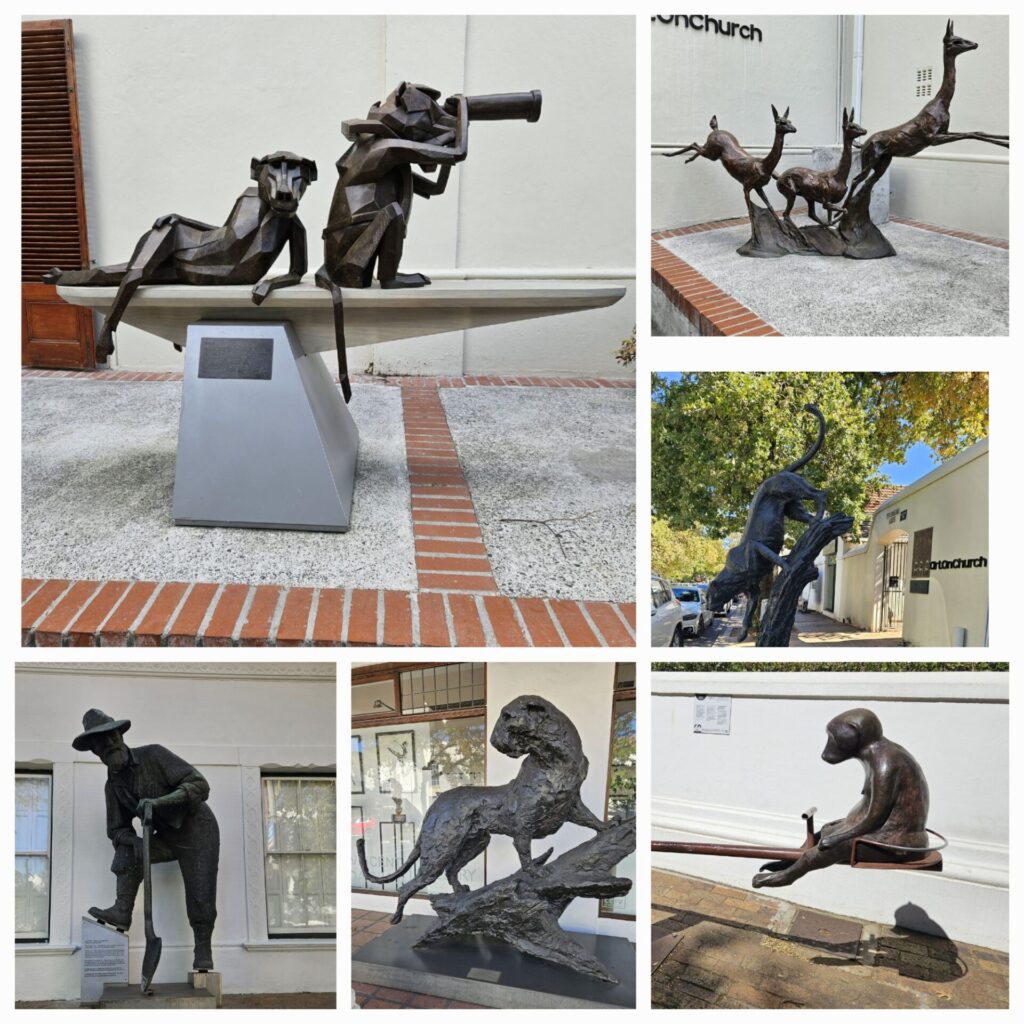
and some houses have 2 street numbers (dutch and english but they both used different systems so they don’t match, even the odds and evens were on different sides of the street!!), visited the museum with its 4 historical houses narrated by locals in costumes of era of each house, loved the cafe culture and the very reasonable restaurants, and the 23 art galleries – there are some stunning sculptures around the streets
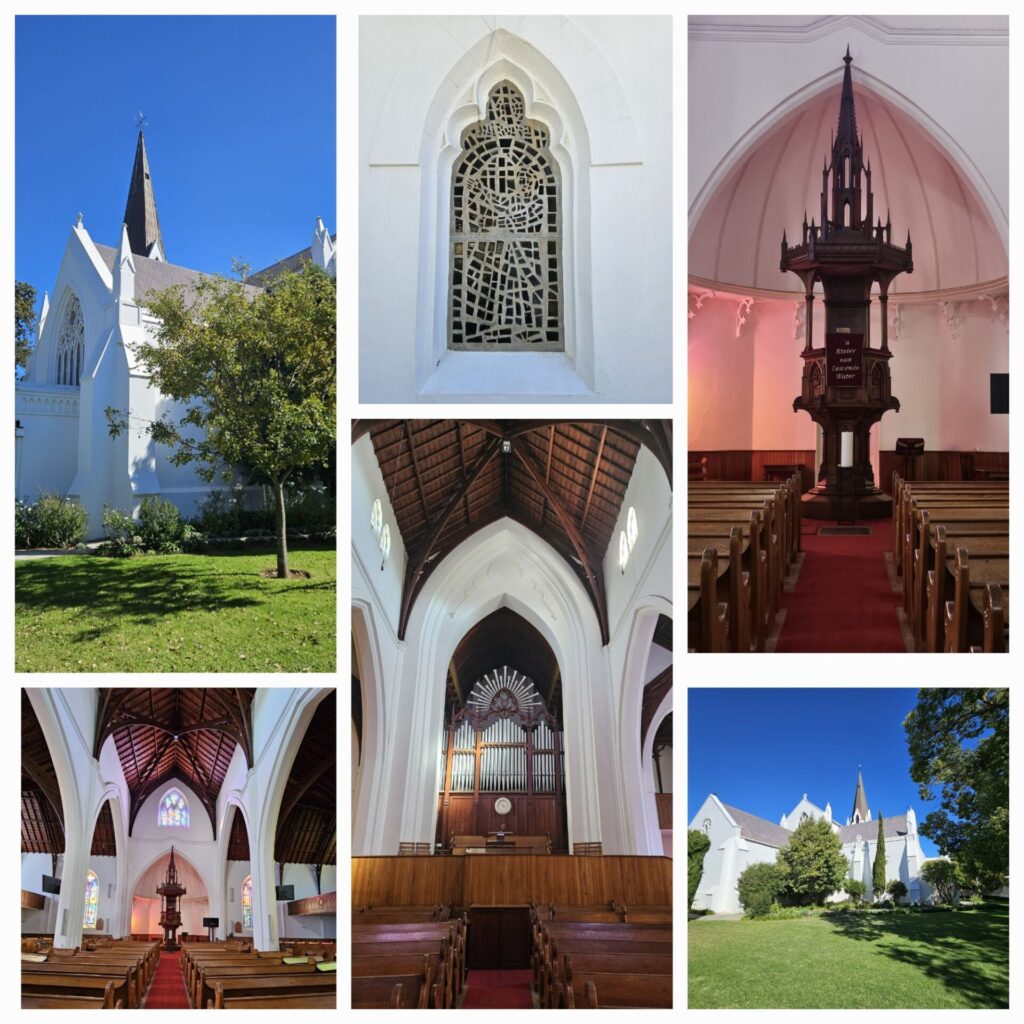
– admired the historical thatched and gabelled buildings and visited the beautiful church (Moedergemeente) that has undergone various changes and was moved after the first one was destroyed by fire.
Moedergemeente
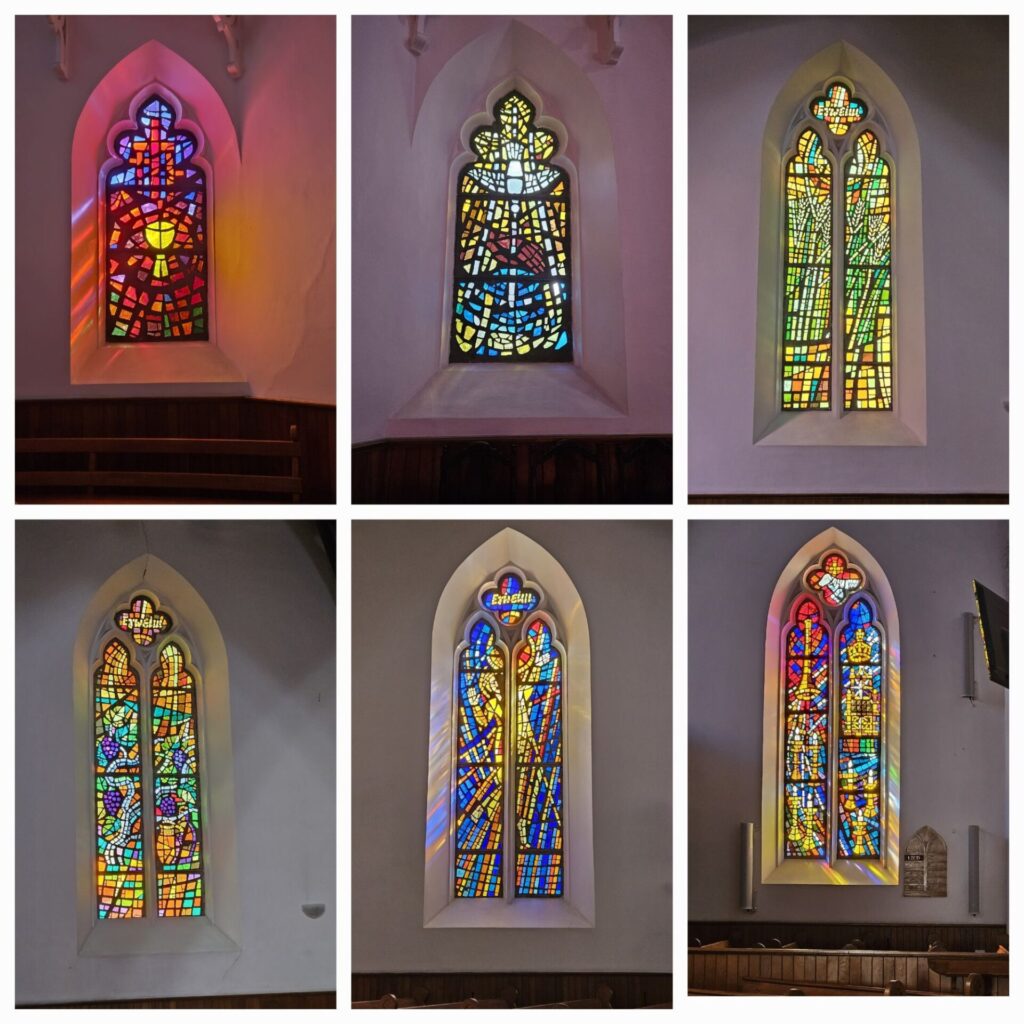
The stained glass windows are lovely and made to a French method using thick coloured glass embedded in concrete!
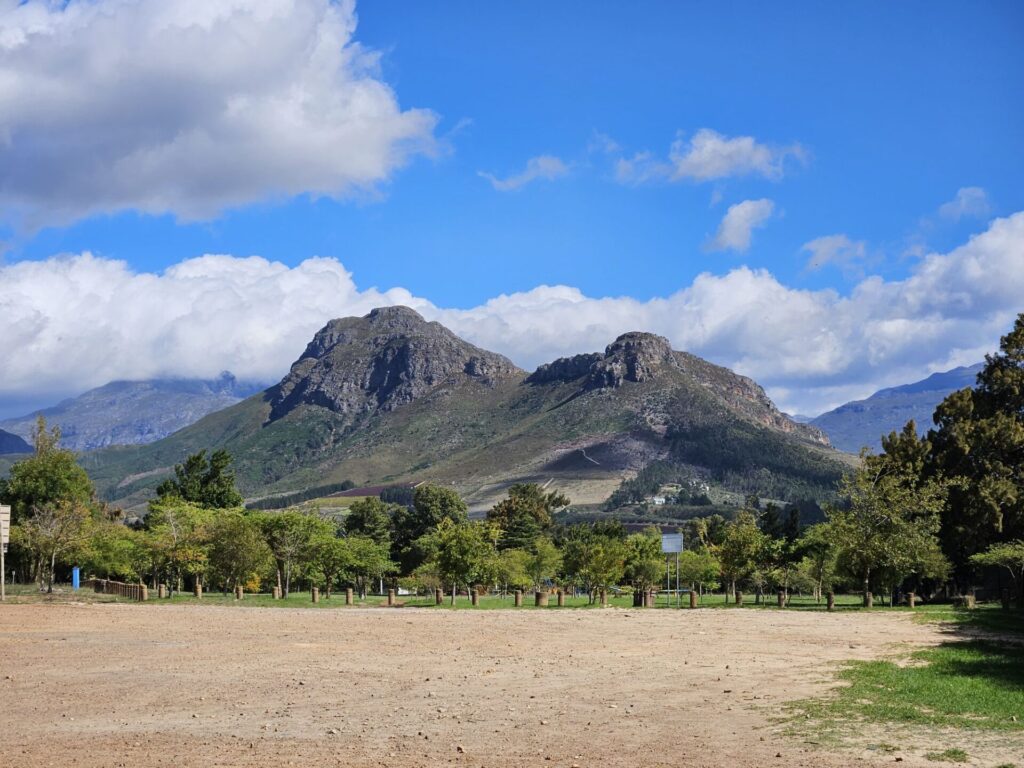
After the university town of Stellenbosch, we then spent a couple of warm, sunny, autumnal days in beautiful Franschhoek. Set in a valley surrounded by stunning mountains you don’t tire of watching
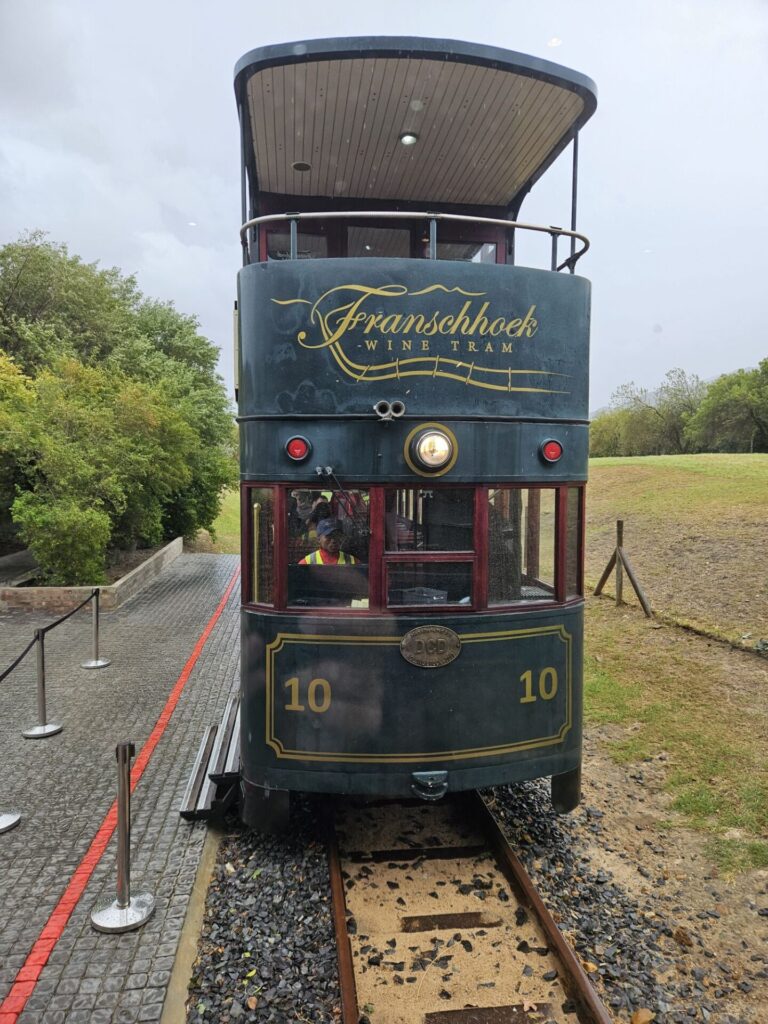
and, of course, among many vineyards and fruit farms. You can do one of the 5 lines on the wine tram if you wish – a good way to do some tastings and not drive. It was fun to see the old double-decker tram rumbling along the tracks
Wine Tram
and the vineyard farm trailers waiting at stops to take people to the estates for tasting experiences. However, weirdly we were a bit “wined out” (is that even possible?) and so went to Babylonstoren for the day – an enterprising concern of winery, farm, hotel, restaurant, spa, farm shop and beautiful gardens (as visited by Monty Don 5 years ago).
Kitchen Garden!
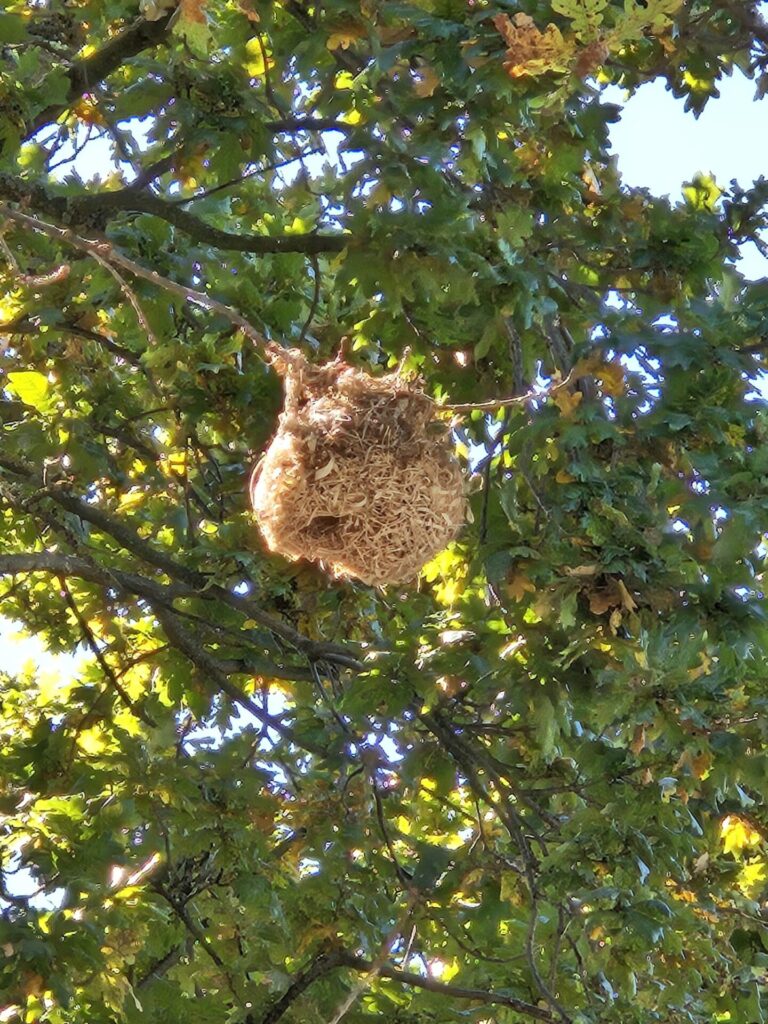
It is well laid out and easy to explore, with staff happy to stop and chat about what they are doing – whether it be in the orchards or finding out about the weaver nest I spotted in a tree.
Stunning nest building skills on show!
From May to October ish they try to be self-sufficient with their fruit and veg production. They have 800 staff looking after 3000 hectares of various different crops. We tried their delicious Gliding Platter, featuring their persimmon, radish, smoked trout terrine, smoked salmon and hummus, and accompanied by a glass of rose and a cloudy pear juice for the driver (Andy!). Franschhoek itself is lovely to walk around, with lots of high-end shops and restaurants to try out along with the wineries.
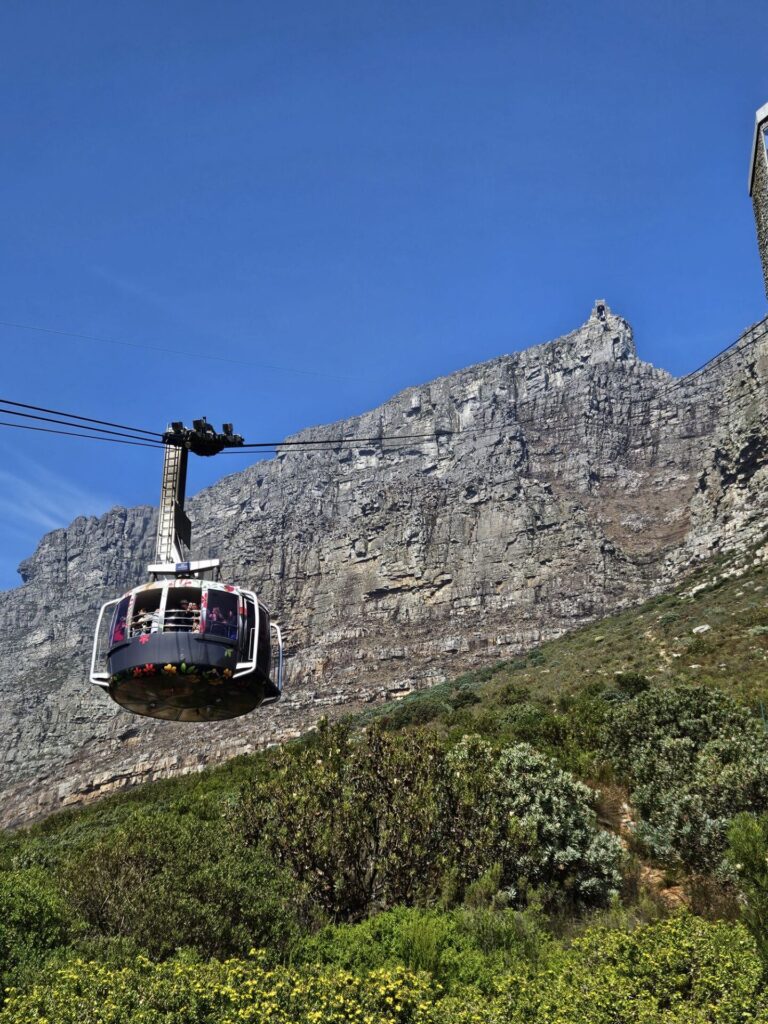
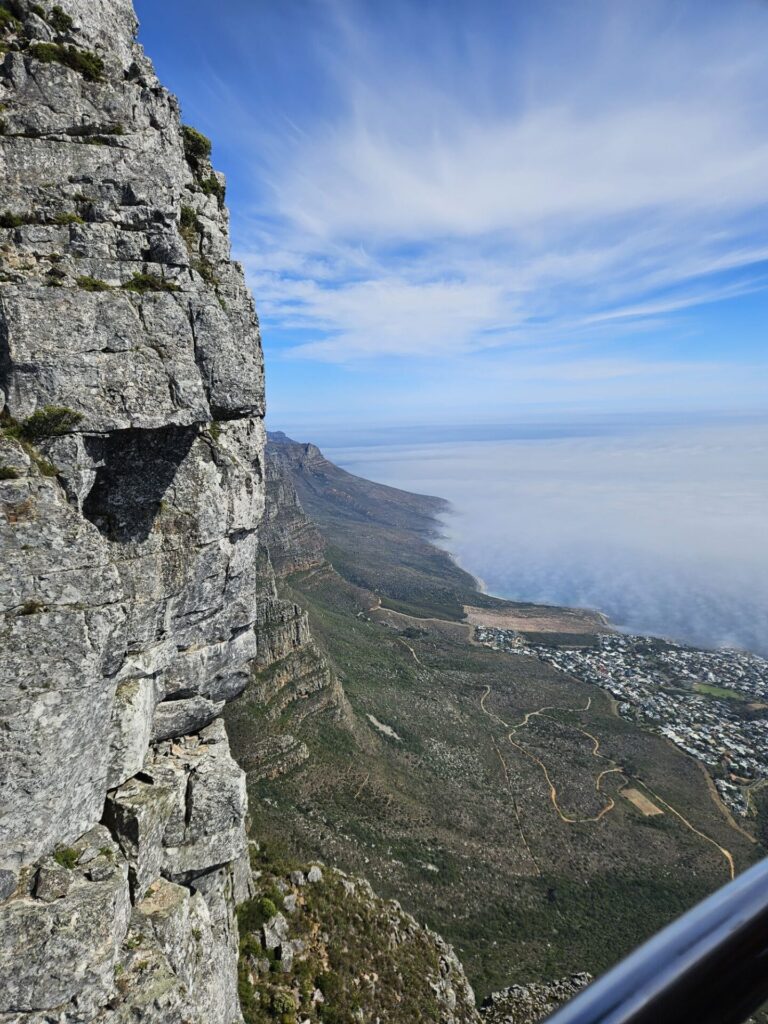
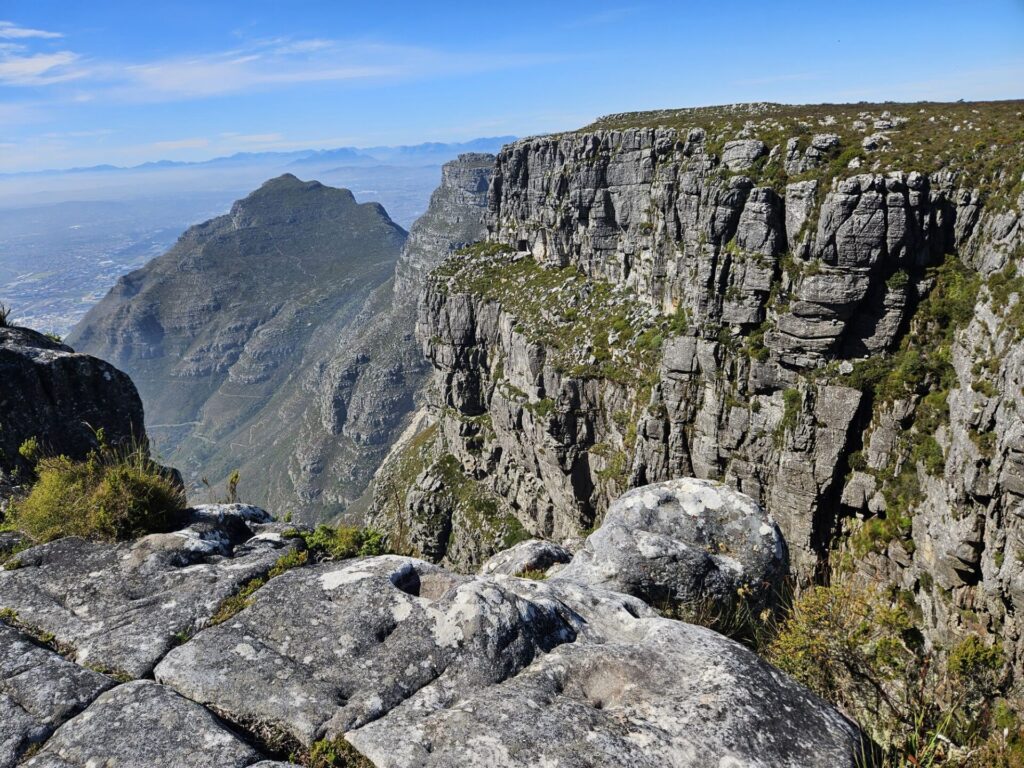
We had one more day in Cape Town after returning from Franschhoek and it was full thick fog in the morning but thankfully it cleared so we eventually got to go up Table Mountain and goodness me, was it worth the wait. We took the cable car up, which actually rotates during the 4 minute journey so everyone gets a good view
Going up!
(you can check online to see if the mountain is open, what the conditions are and how long the wait times are for the cable car which is really useful. We bought a combined hop on and off and cable car ticket). It was stunning on the mountain, and we spent a good 2 hours walking around the top, watching the sea fog swirl around the coastline, making it look very eerie.
Watching the sea fog from the cable carOn top of Table Mountain
And so it was time to say farewell to South Africa (for now) and sadly end our Grey Gap Year with a flight back to the UK.
We boarded the Ambssador cruise ship Ambience in Singapore on its inaugural world tour, and we were just doing one 25 night leg of the trip.
Joining a ship half way through a world tour has proven to be an interesting insight into the human psyche – the cliques have already formed, favourite quiz tables and theatre seats identified, Queen and King bees have amassed their audiences, interest groups have developed waiting lists, destination experiences nearly fully booked up and heirarchies have been forged – and then in come the “interlopers” causing ripples to run through the various groups dynamics.
There is no “free dining” times on Ambassador so we elected to try the 6pm sitting on a table for 6 and we were very lucky with our wonderful dining companions Sue, Liz, Peter and Denise and subsequently had some very entertaining times with them.
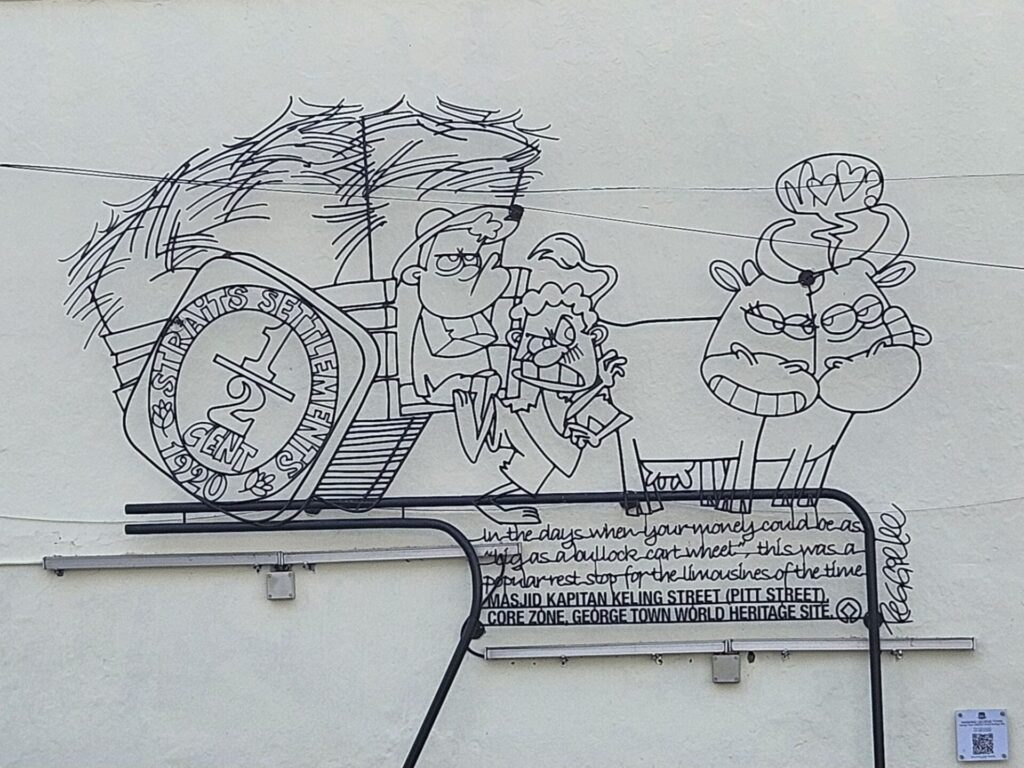
Our first port of call was Penang , which we’ve visited a few times, so we just had a wander around Georgetown and enjoyed the wall art and the colours and smells of the spices in Little India,
Georgetown wall art
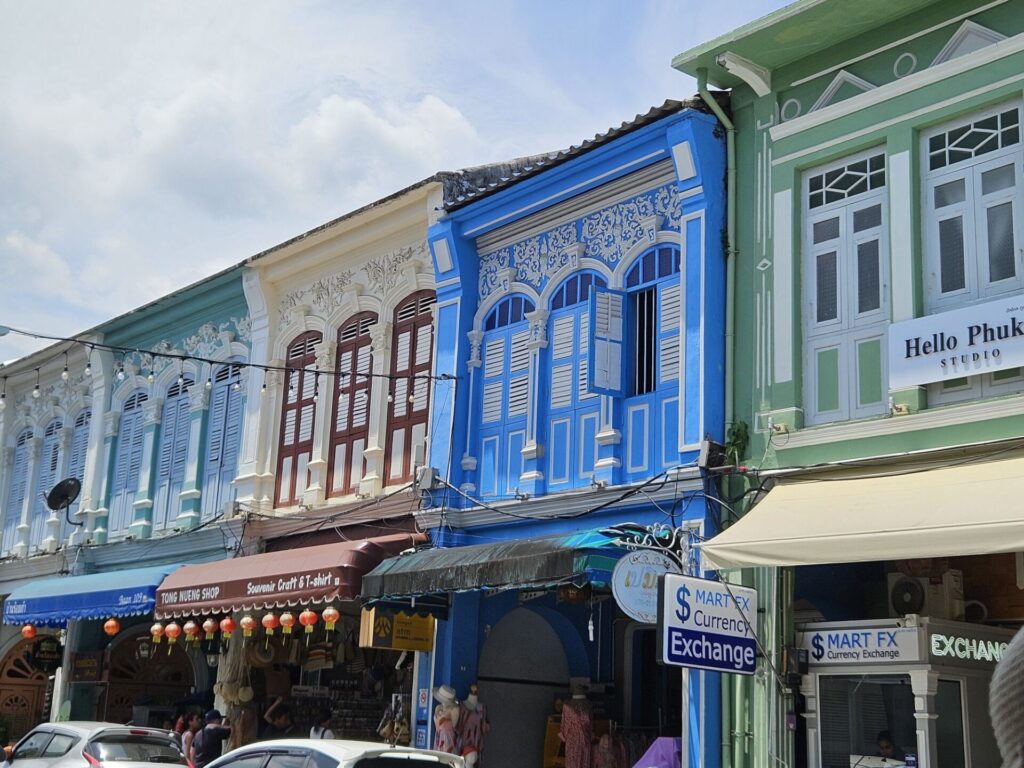
then onto Phuket – ww were moored miles away so had to take a taxi to old town for an explore of the Wats, old streets (reminiscent of Melacca) and enjoyed a Singha beer and mango, sticky rice (yum). Then had a crazy tuk tuk taxi back to the ship! That nights entertainment was the Lady Boys of Phuket – an excellent show that the locals put on for us.
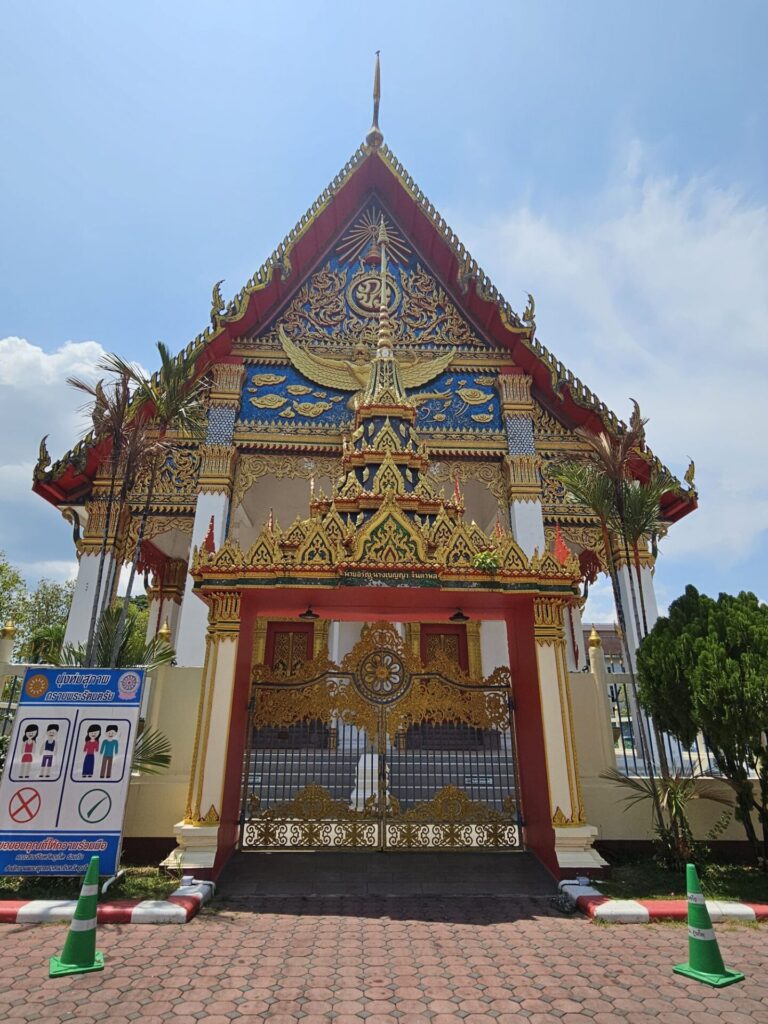
Phuket Old TownPuttamongkon Nimit Wat
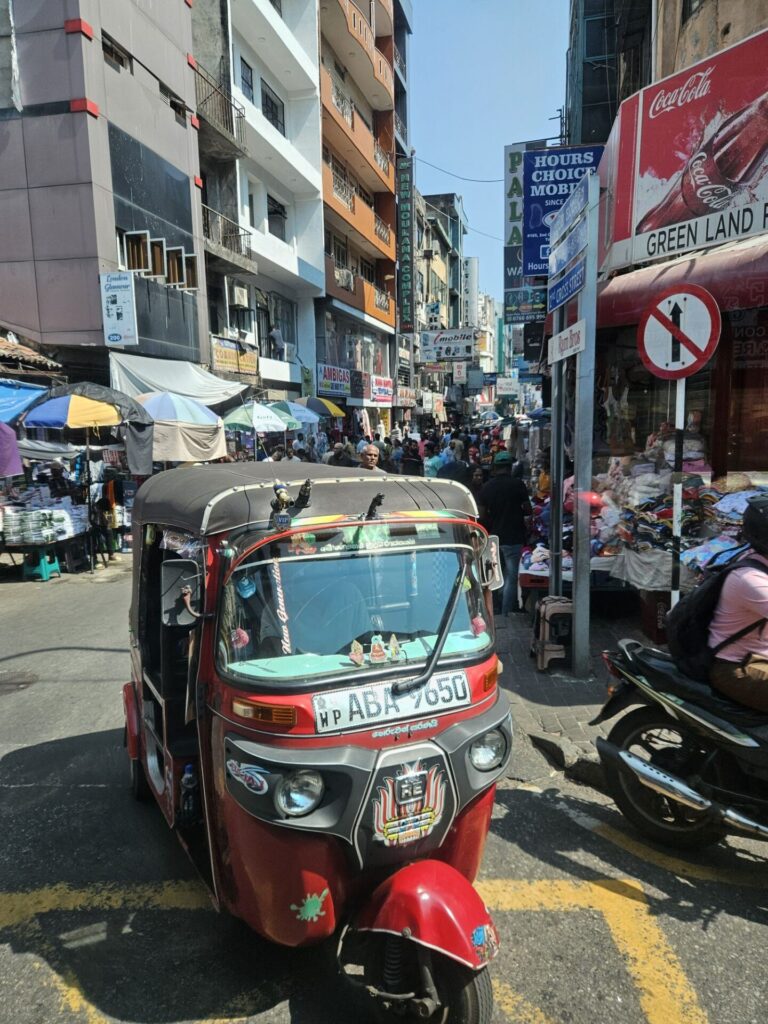
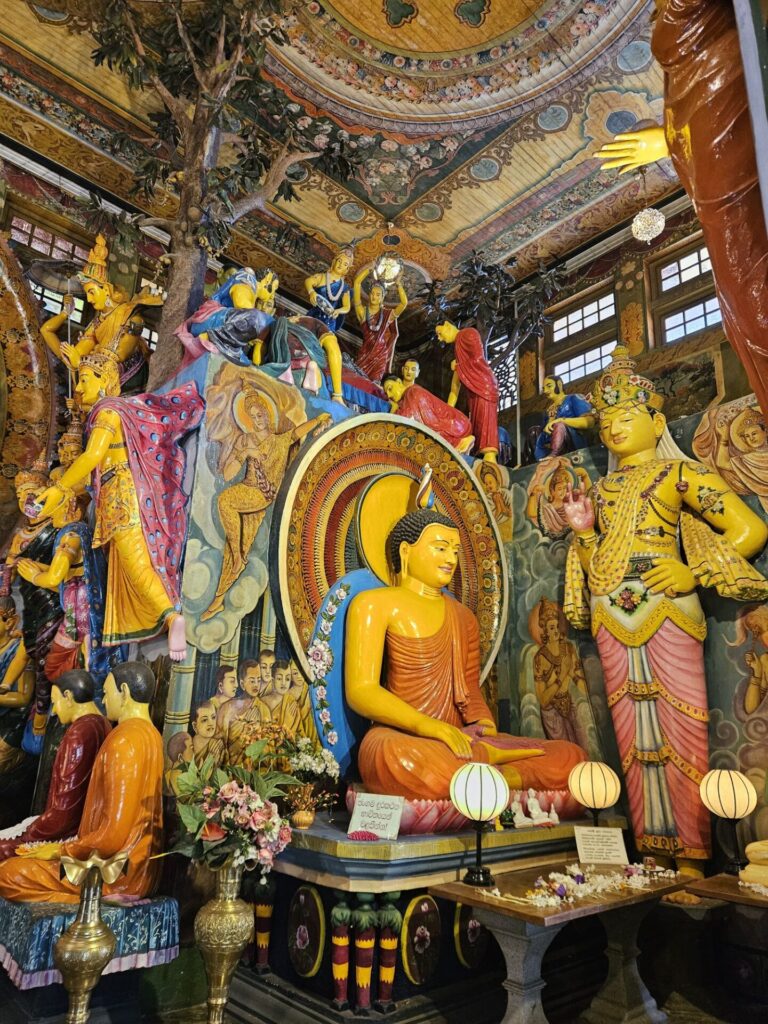
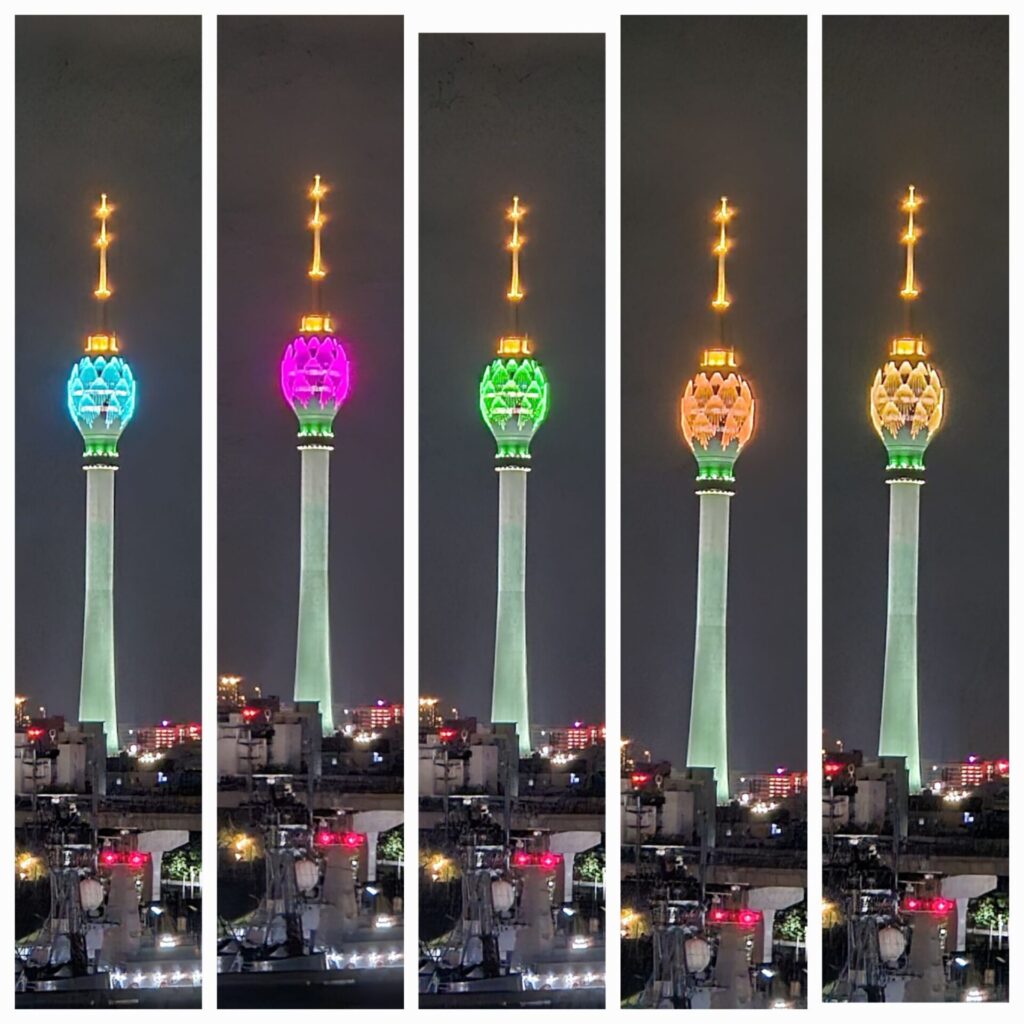
Next stop – Sri Lanka and its crazy capitol – Colombo, where we took a tuk tuk trip around and visited a stunning temple, complete with donations from Rolex watches to an old Rolls Royce car! Again, we had an excellent show from Sri Lankan locals that evening before we sailed away. It was lovely to see the Litus Tower all lit up.
Tuk tuk in ColomboTemple in ColomboThe Lotus Tower at light in Colombo
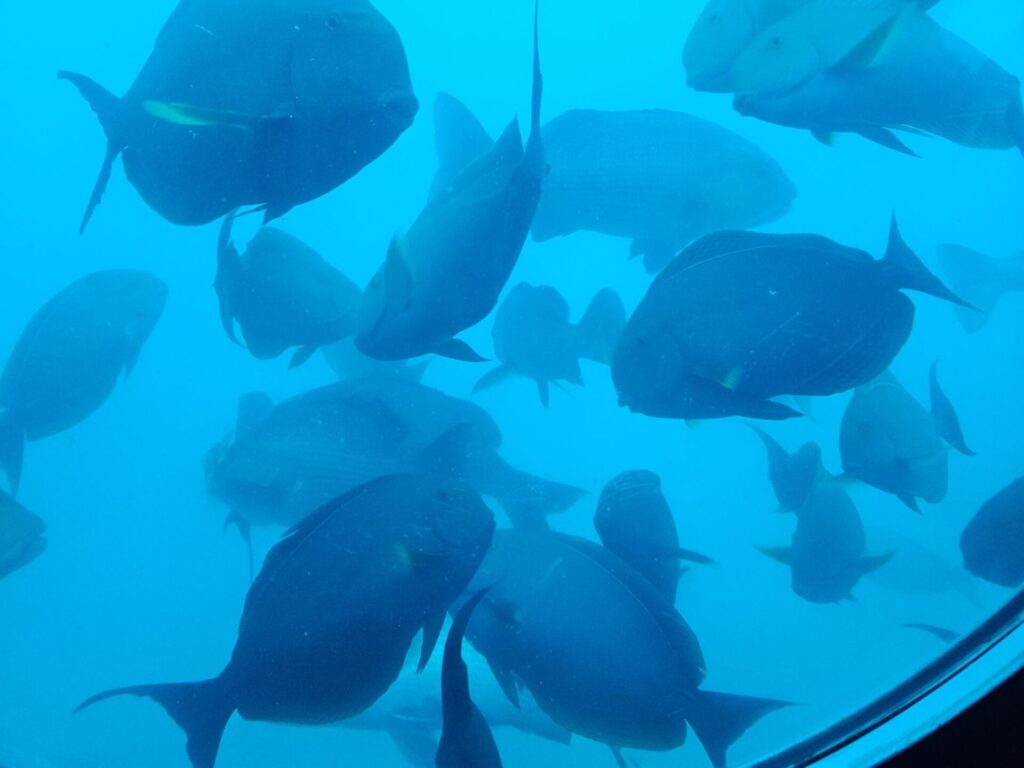
Male in the Maldives was next – not at all what you see in the tourist brochures – for that you need to get out to the atolls and big resorts – we just did a submarine dive but sadly, although lots of fishes, the Reef looks in a bad state.
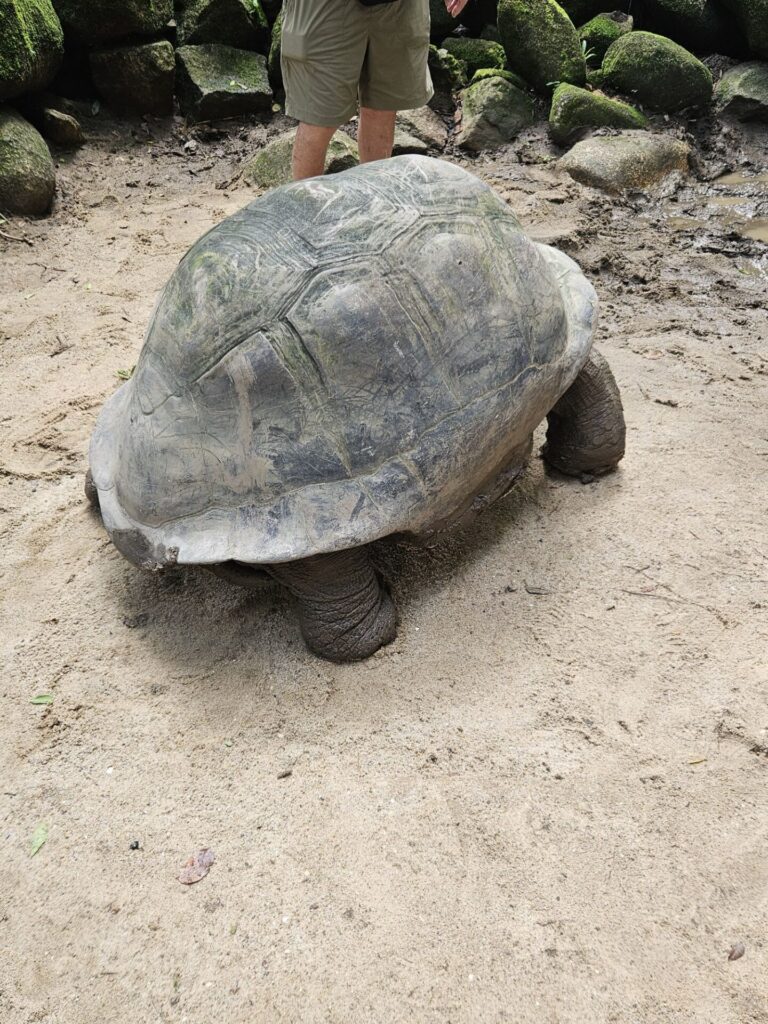
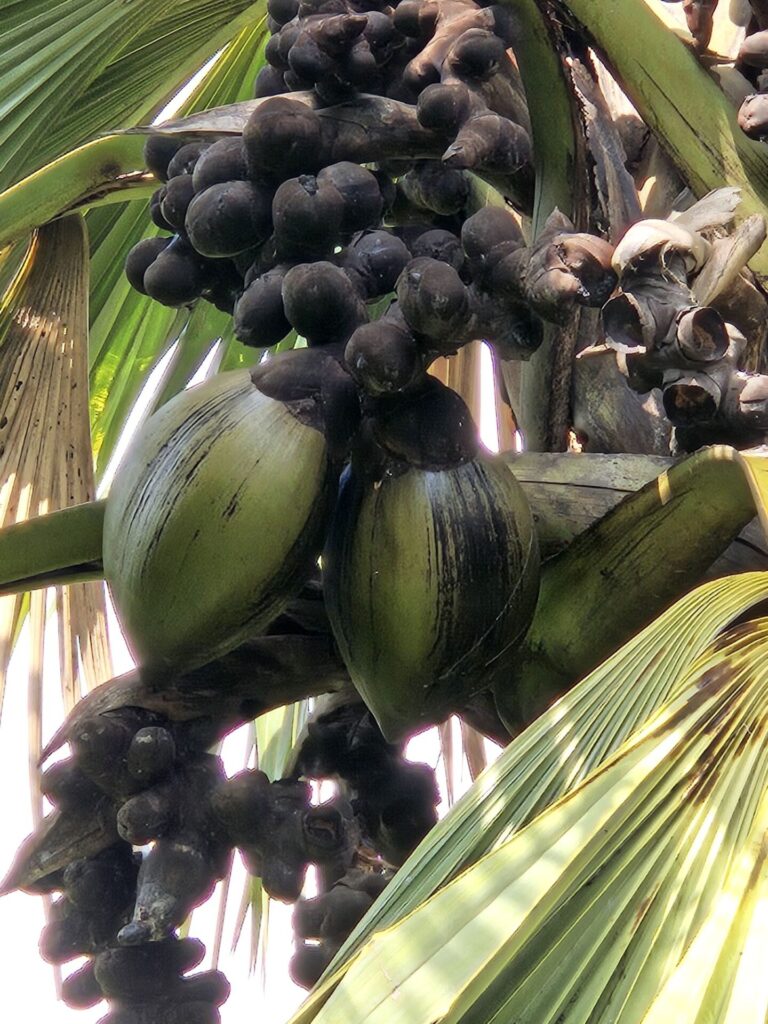
Then onto Mahe, Seychelles, which was much more our style with lots of lush green hills. We did a tour of the botanical gardens to see the famous Coco-de-mer double coconut and the giant tortoises
Giant tortoiseCoco-de-mer
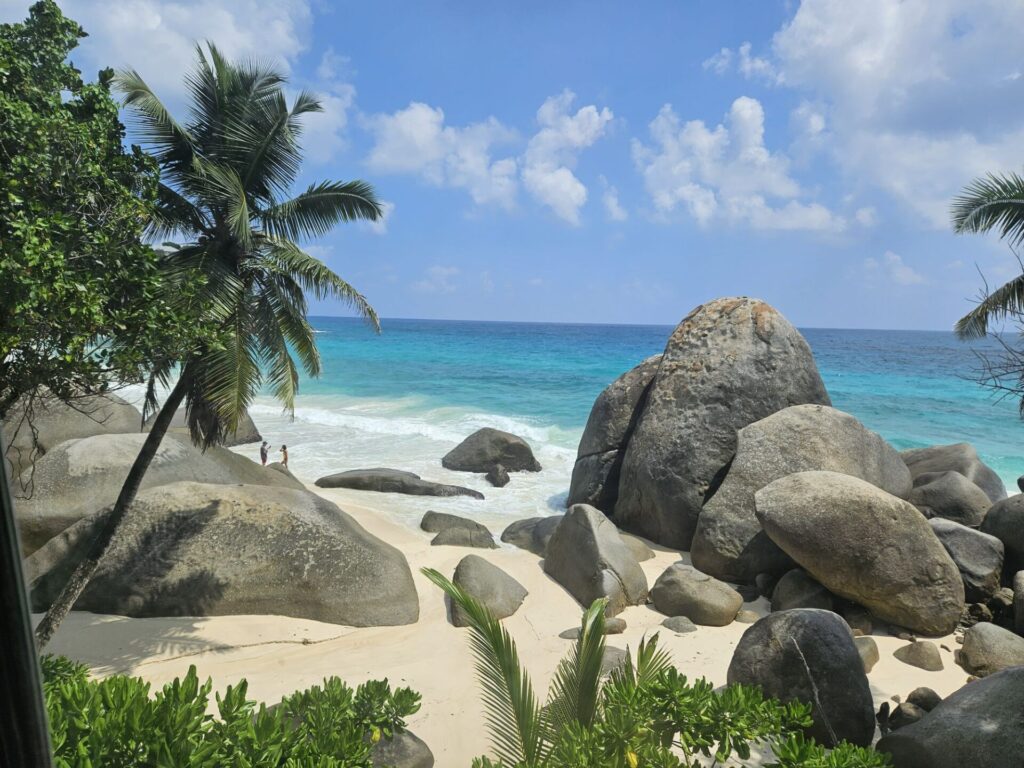
and then a quick trip around the north of the island – very beautiful.
North coast of Mahe
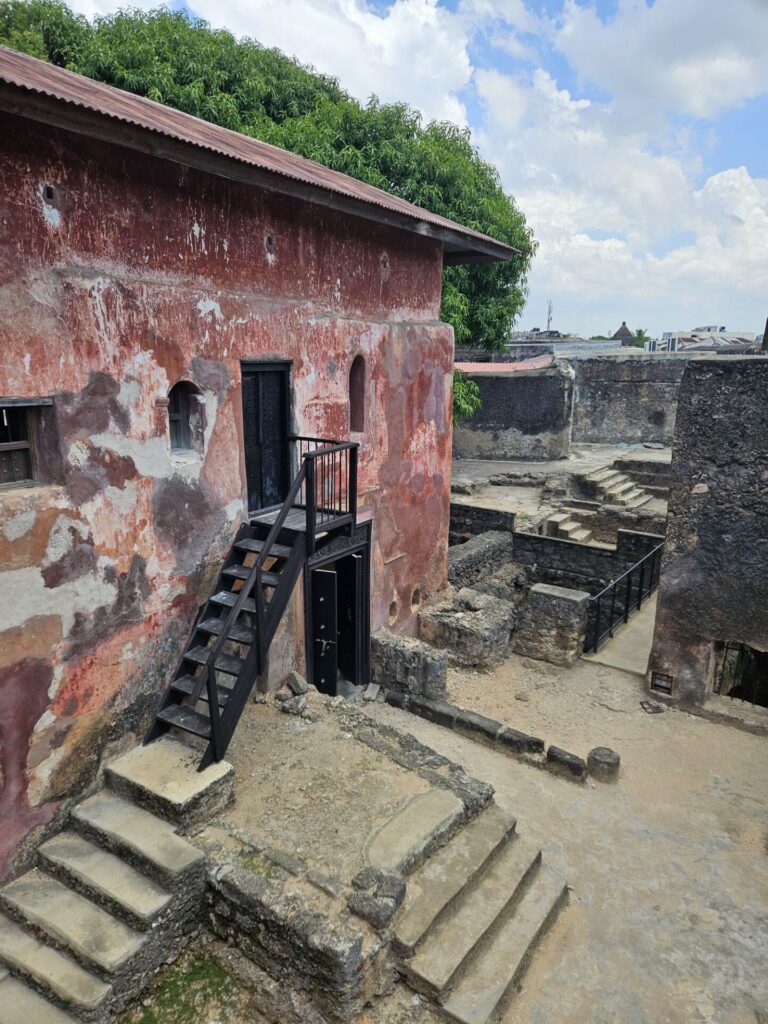
Then it was 2 days in Mombassa where the ship was met by local tribes dancing and drumming (they certainly have plenty of energy!) Sadly, Andy wasn’t too well, so we just visited Fort Jesus on the second day, which was very interesting, but it was extremely hot and humid! The port put on a shuttle bus to a hotel in town, which was safer for visitors.
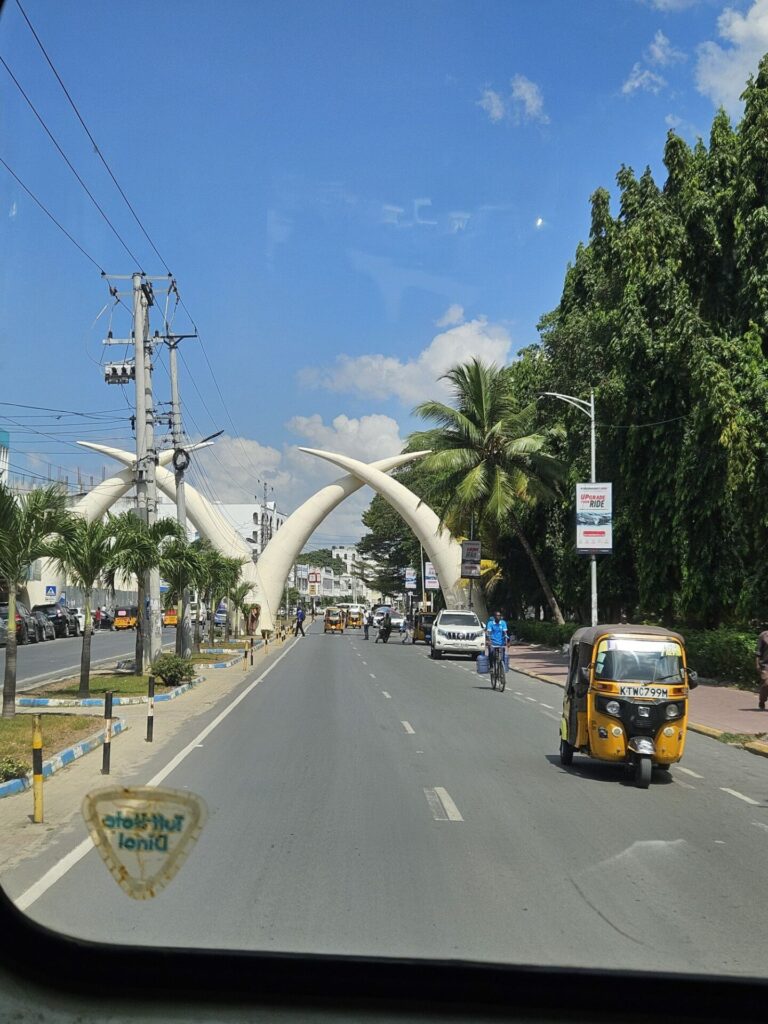
The Mombassa Tusk ArchesFort Jesus
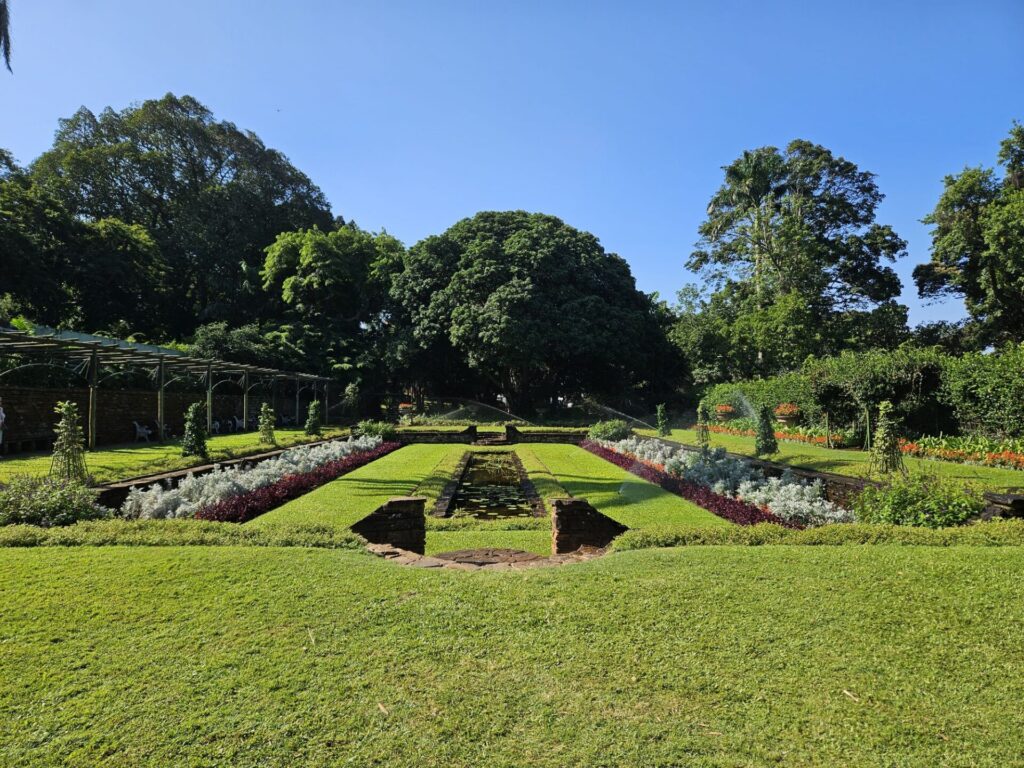
Durban came next, not sure what we were expecting, but we enjoyed it here – took a walk to the Golden Mile beach and a bus tour out to the botanical gardens where we saw pelicans in the trees, weaver bird nests and some ducklings,
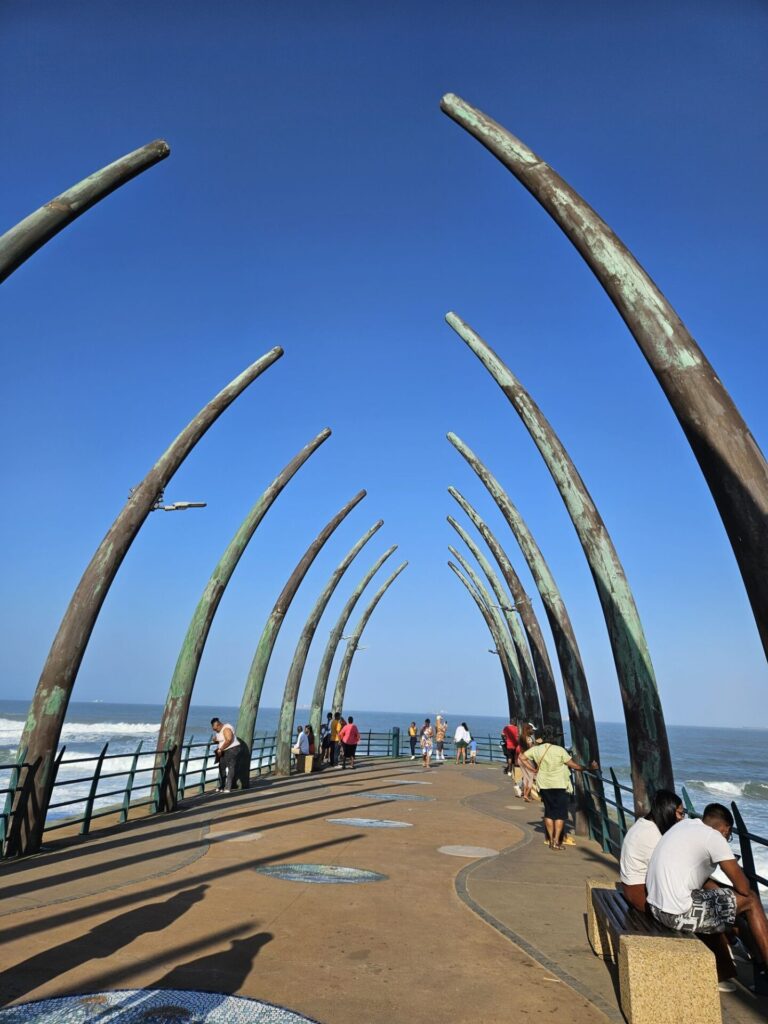
Victoria market, whale bone pier (not real whale bone)
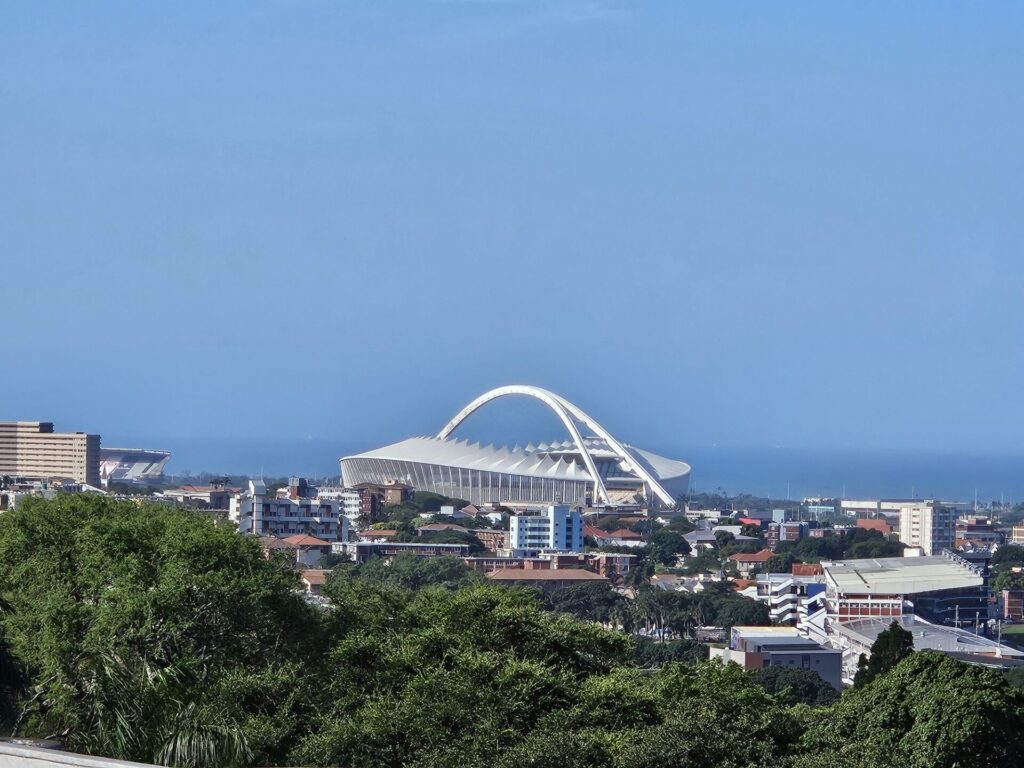
and past the stunning Moses Mabhida stadium with its graceful arch – the Arch of Triumph
Moses Mabhida Stadium
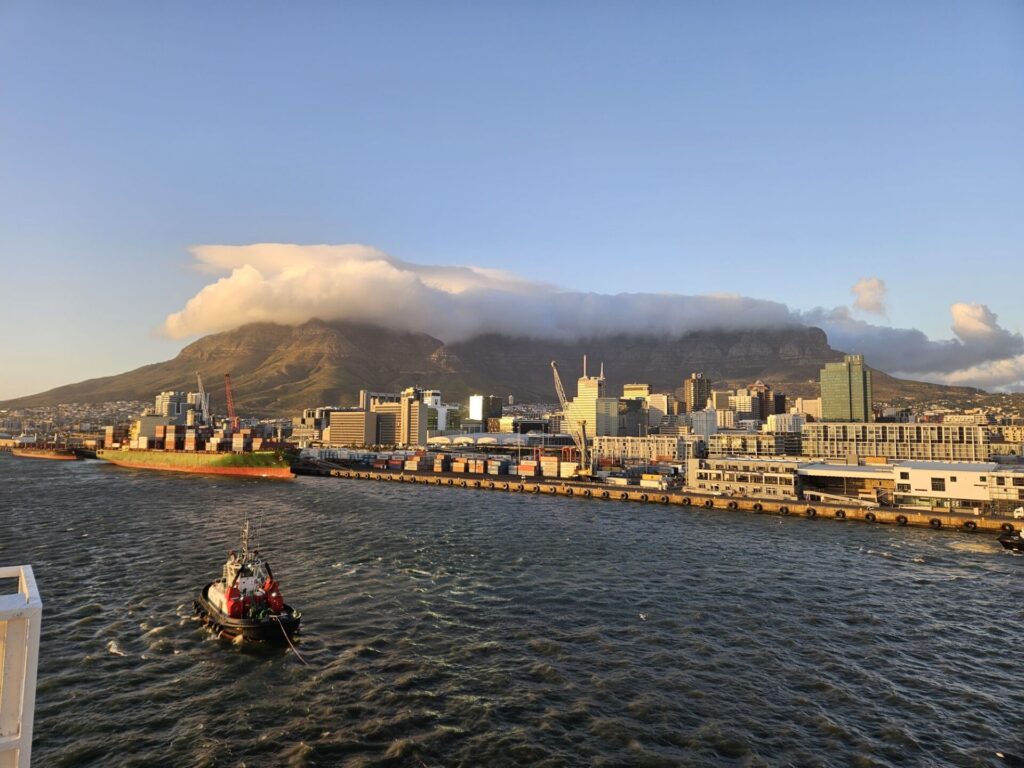
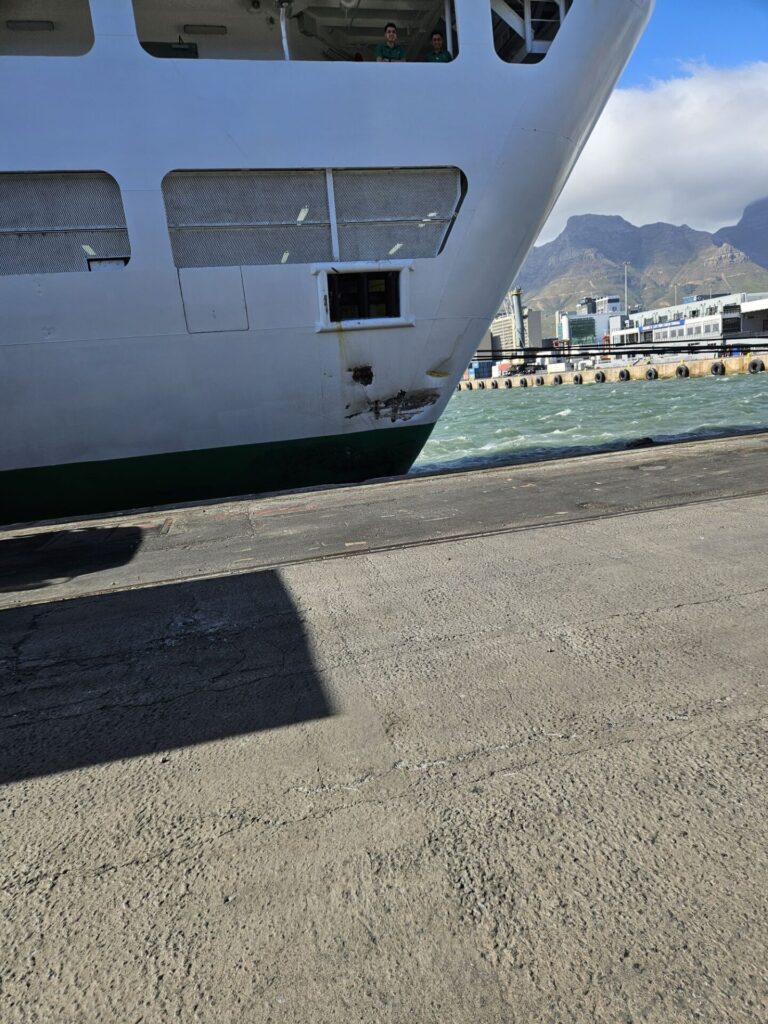
Then finally to Cape Town and our ungainly entrance to the port (we collided with a cargo ship when high winds took the ship away from the tugs)!!
Table Mountain with her table cloth on!Oops!
We were glad to get off – 25 nights is way too long for us, but it got us to where we wanted to be, we visited places we have not seen before and made some new friends along the way.
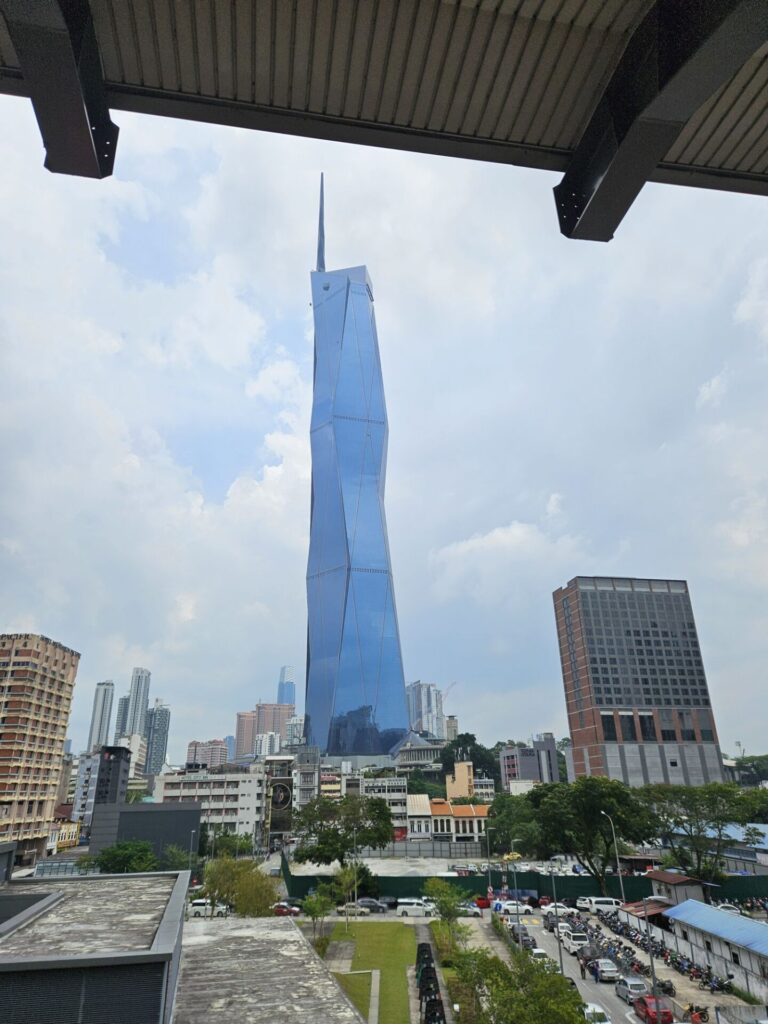
We spent a week in Kuala Lumpur revisiting old haunts – it was interesting seeing what has changed in the last 10 years and what hasn’t. It’s still a great city of vibrancy, a mixture of cultures and languages. We had fun trying out our rusty Bahasa Melayu (it’s surprising how much comes back when you start talking), eating lots of roti canai and exploring. There are many new buildings, including the huge blue multi-faceted Merdeka118 tower – the second highest in the world.
Merdeka 118
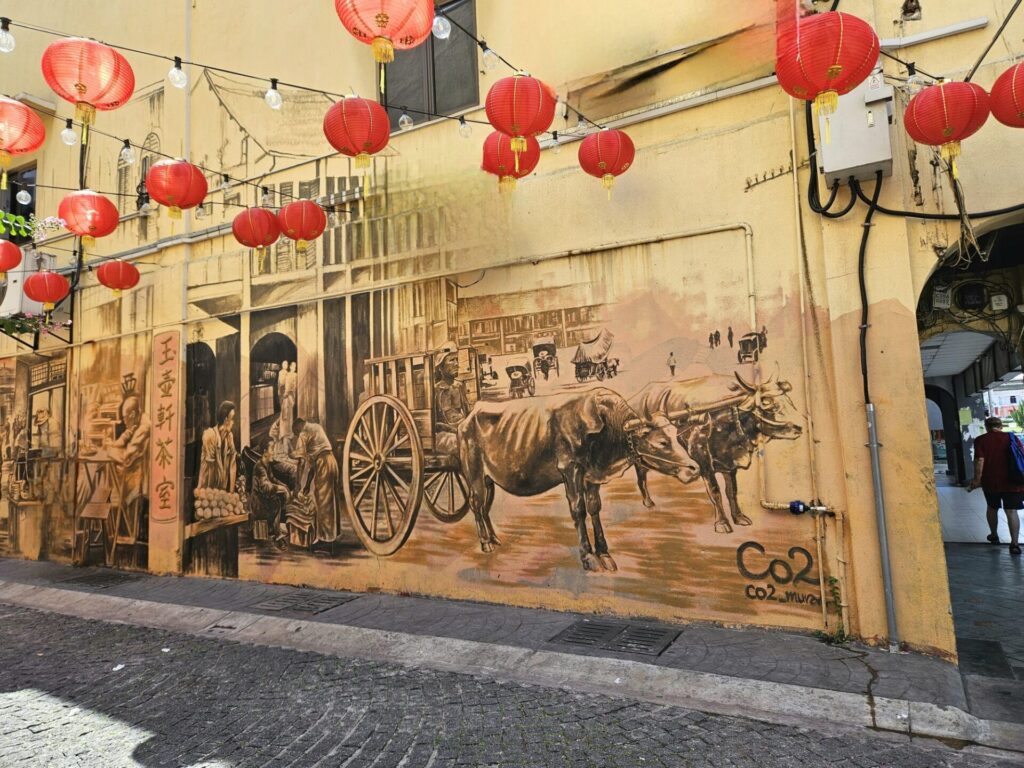
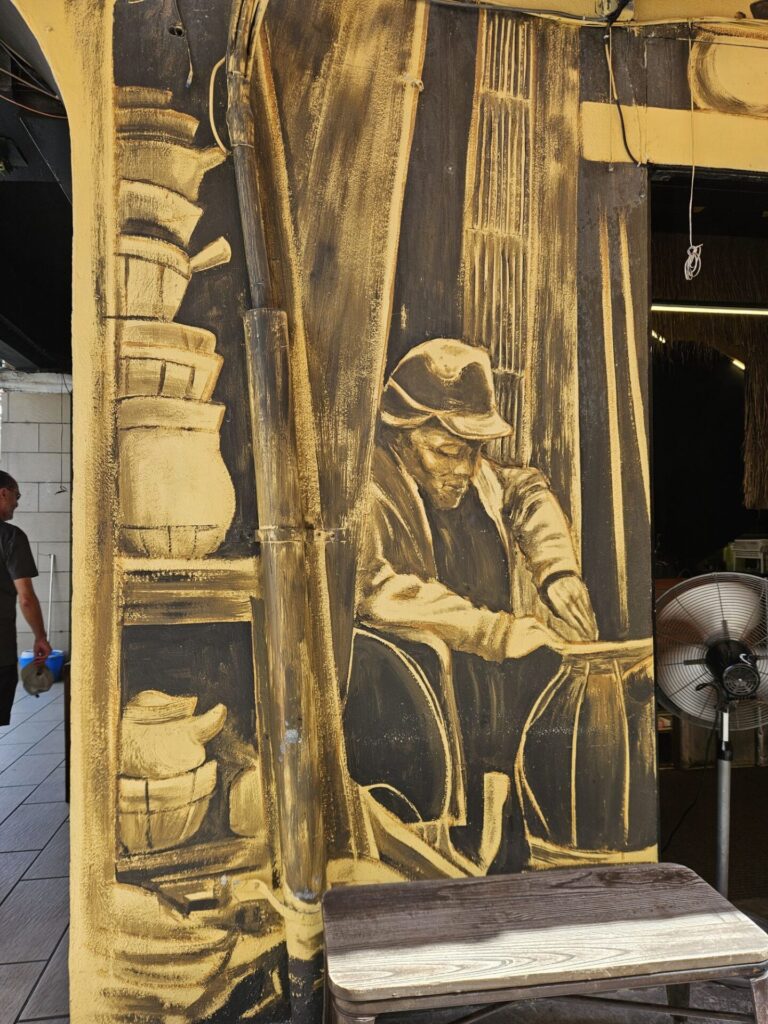
It has been opened but not to the public yet. Chinatown is still the same ramshackle area but now has some interesting murals
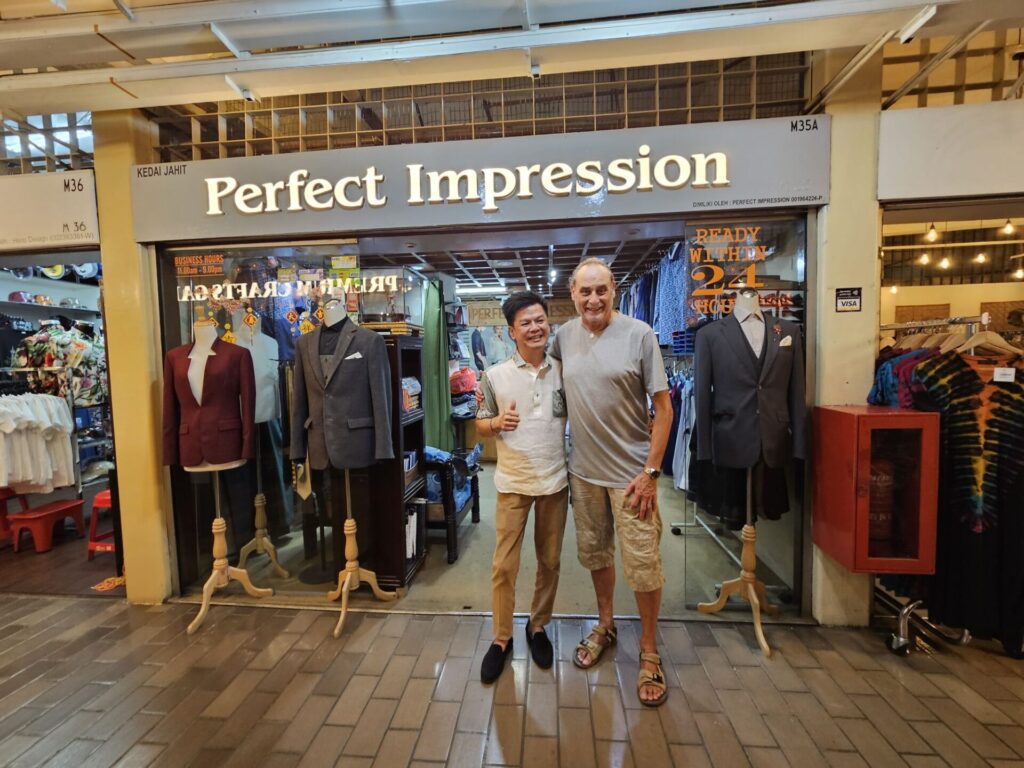
and Central Market, whilst suffering from loss of shops during the pandemic, has remained open. Not sure we like the new makan hall as it doesn’t seem to fit in with the arts and crafts history and style of the market but we did love that Andy’s old tailor is still trading (and made him a new shirt!!).
Perfect Impression, Central Market
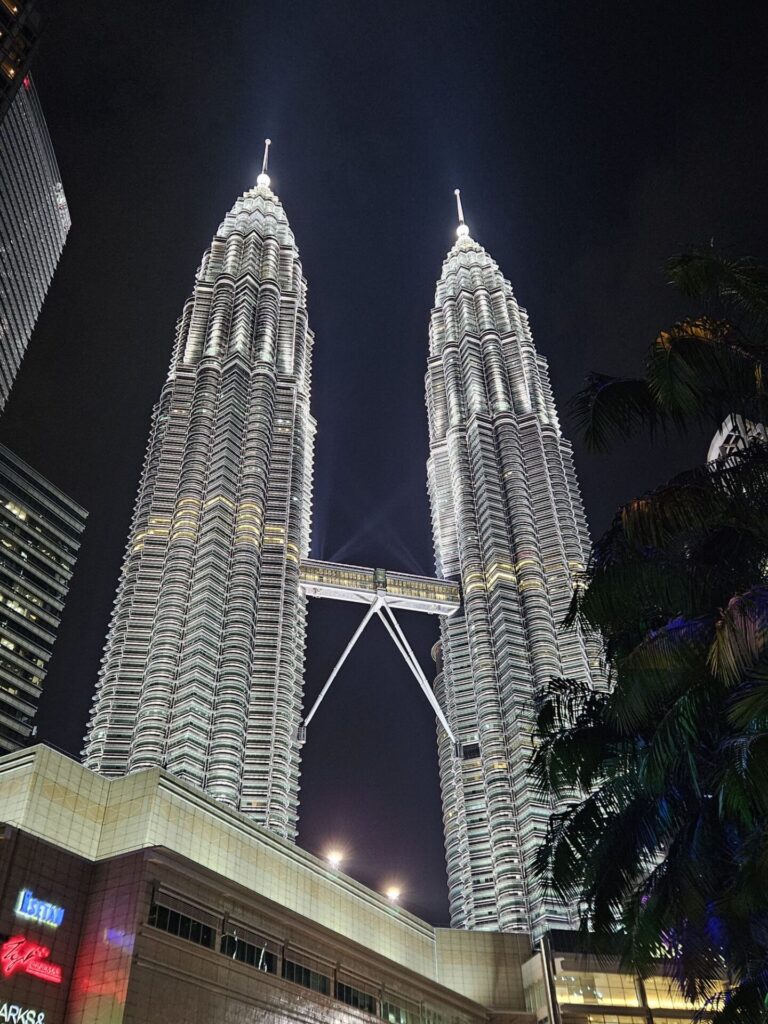
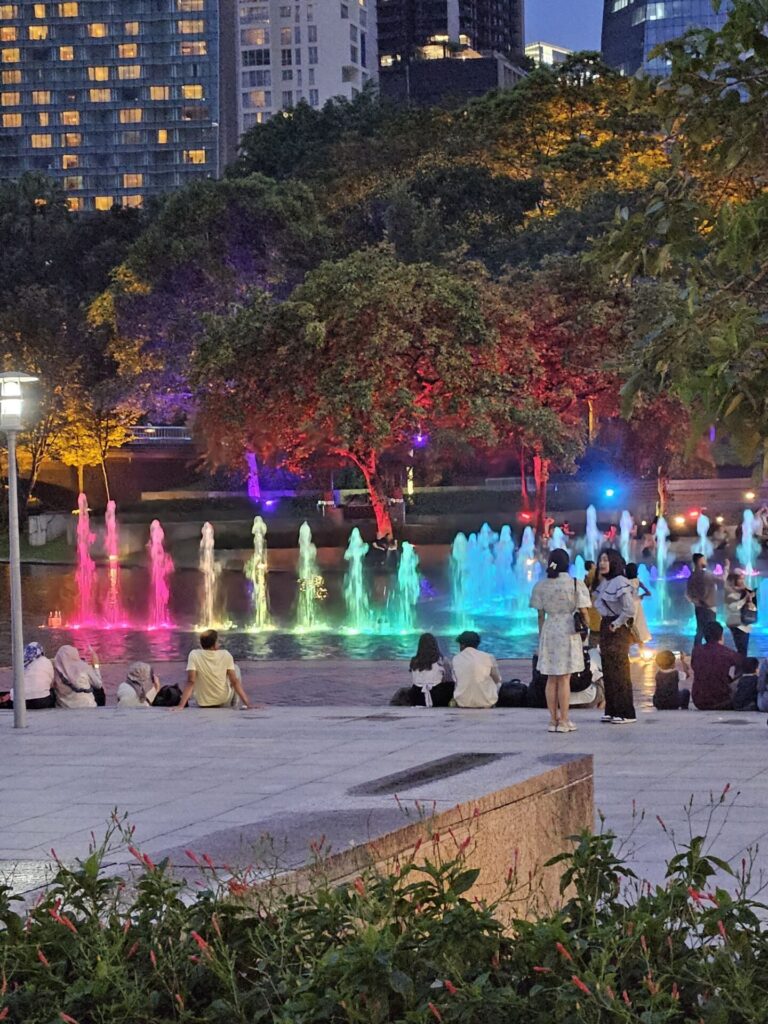
And of course we had to visit my favourite towers, glittering in the night sky. I fell in love with the Petronas Towers back in 2010 when I first saw them looking like crystal in the night sky – they still enthrall me and now there’s a lovely evening musical fountain display in the gardens behind KLCC as well.
Petronas Towers
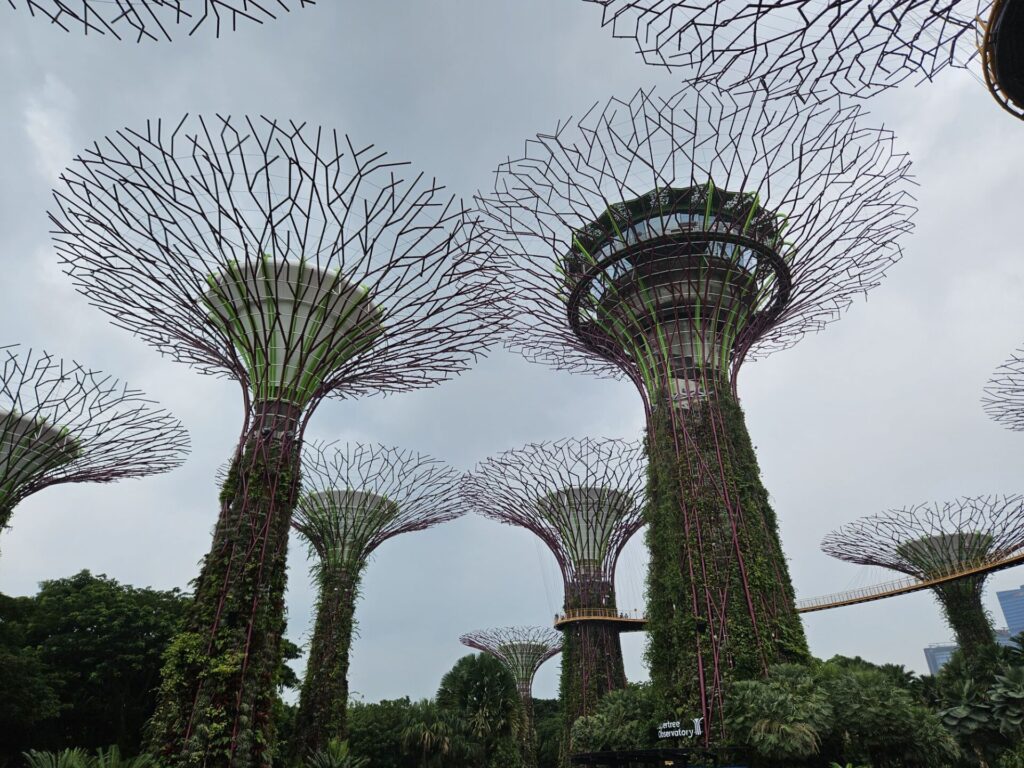
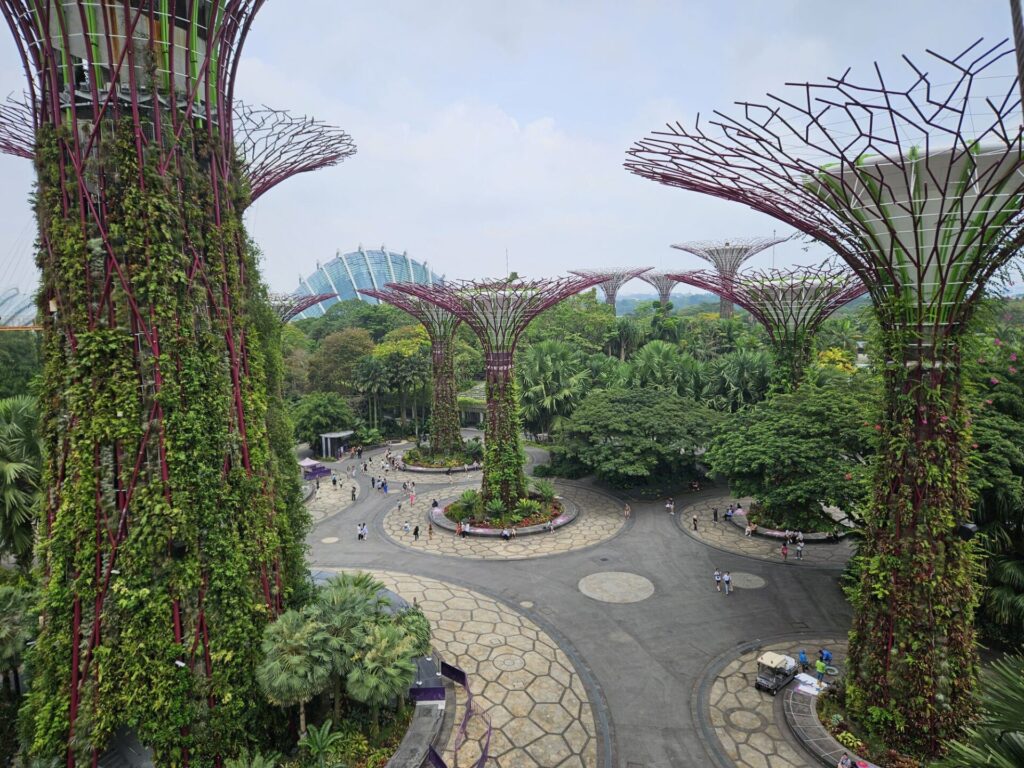
It’s still cheap to eat and to get around on the monorail, MRT and LRT but now transport is a bit more joined up, which makes it easier to get around. Next, we flew down to Singapore for a couple of days – ouch! Just as well we only had 2 nights here and used loyalty points to get free accommodation because whilst Singapore has always been expensive, it’s now crazy prices. Still, the buses are cheap to get around on, so we revisited the Gardens by the Bay (last here in 2012) and it was lovely to see how much greener it is now. We even managed to get Andy on the high walk, but we didn’t visit the domes this time.
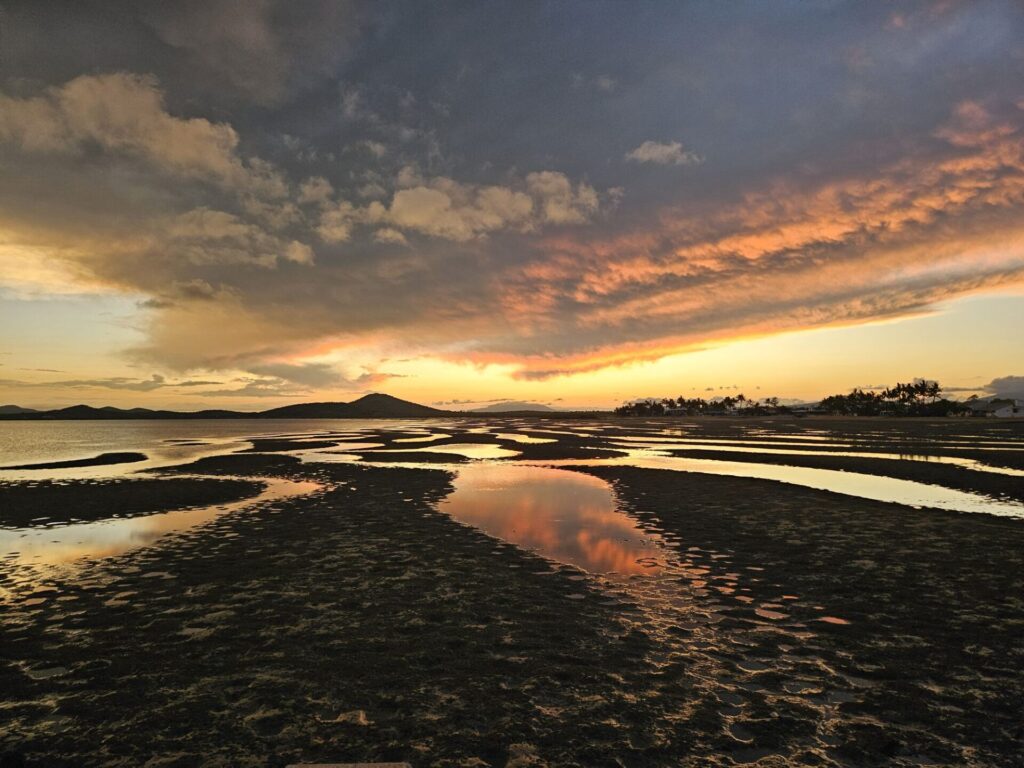
Australia – a huge country of many contrasts, with tropical cyclones in the North and drought in the south, crazy high temperatures in the summer, stunning white sandy beaches and clear blue seas (often colder than you expect), beautiful sunsets,
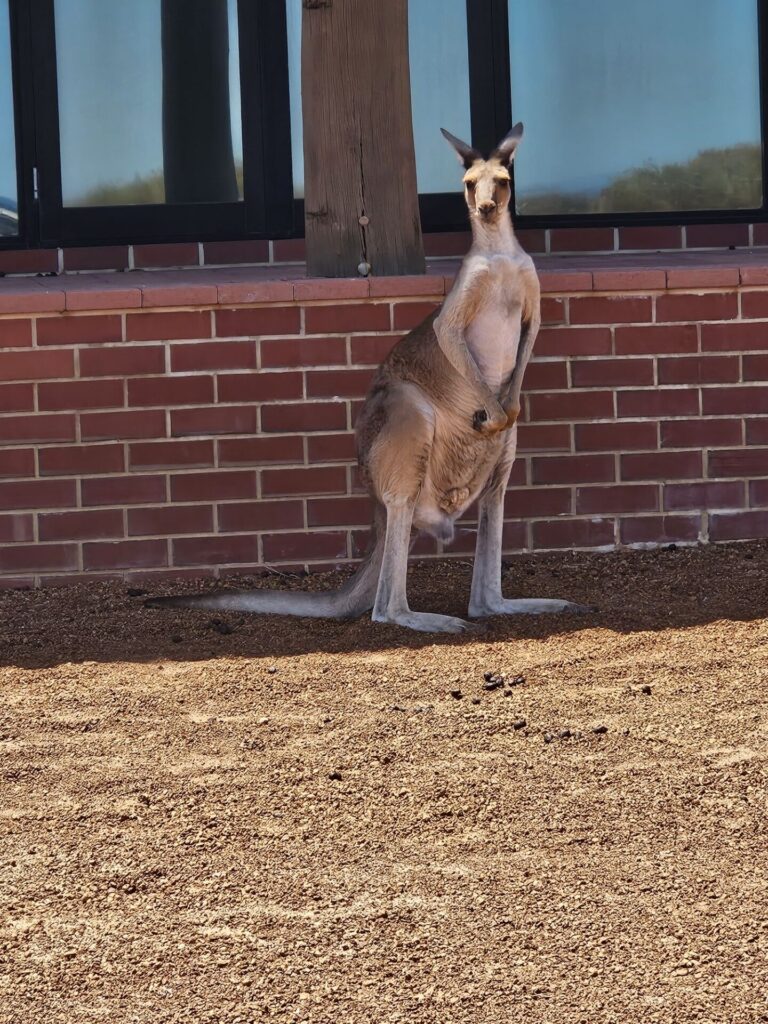
open wheatlands and red earthed deserts, huge trees, some with amazing annual bark shedding abilities, some quirky animals that have adapted to the contrasts of the continent,
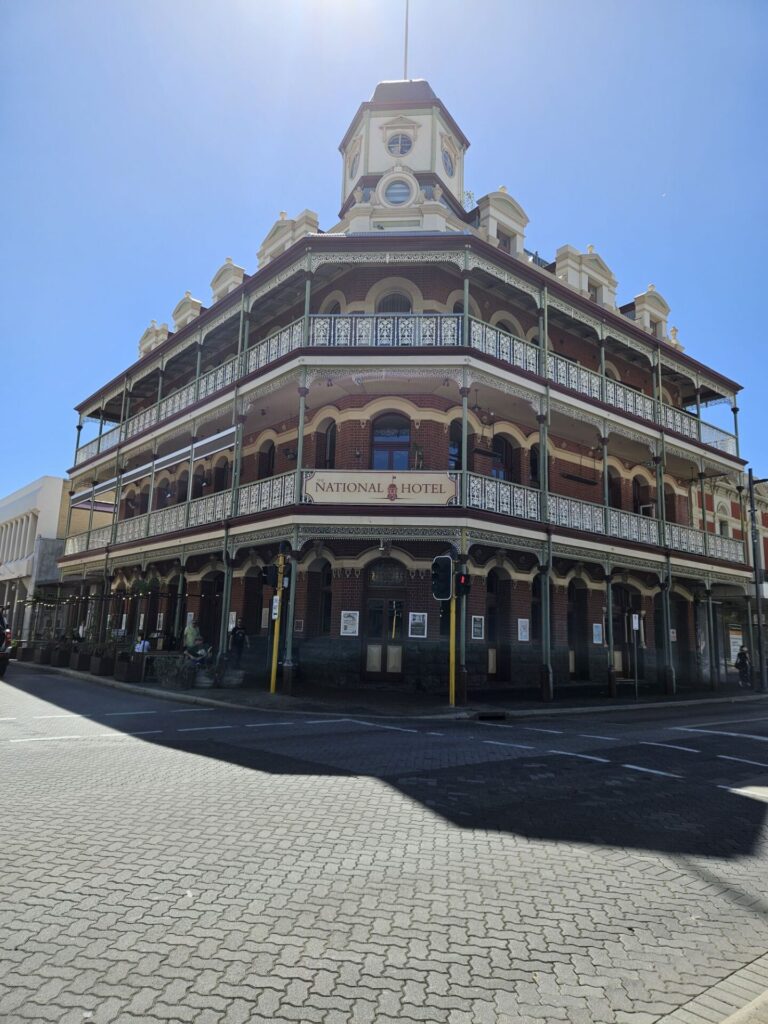
very pretty birds from the tiny blue wrens to the colourful parakeets, gulahs, cockatoos and noisy crows. It’s a land of down to earth people, who tell you how it is – very refreshing! They love their coffee, although often way too tepid for my taste, sandwiches and chicken schnitzels. Oh, and let’s not forget it has more deadly creatures than you would really wish to meet, both on land and in the waters!! It’s many towns and cities were often built from convict trade in harsh conditions – some of this history remains in the ruins of old prisons and convict depots. They have also managed to hang on to some of the historic hotels complete with intricate ironwork verandahs – built on street corners because they had to have 2 entrances – 1 for the bar and 1 for accommodation!
We’ve enjoyed visiting Australia again and having the opportunity to catch up with friends we haven’t seen in many years and to visit different parts of this vast country (we were lucky enough to have visited twice before and to see Tasmania, Melbourne, Great Ocean Road, Adelaide, Uluru, Cairns and the Great Barrier Reef). Now it’s time to move on again (well, an email from Border Control has kindly reminded us that our visas are due to expire next week!). Now we’re off to Kuala Lumpur to see how much it has changed in the 10 years that we visited last.